

Toy Rotation for Twins: The 4-Zone System That Eliminates Duplicate Chaos
Picture this: you walk into your living room and find 47 toy cars scattered across the floor—24 from Twin A’s collection, 23 from Twin B’s nearly identical set. Sound familiar? The reality of twin household management means dealing with exponential toy accumulation, and without a strategic toy rotation for twins system, your home transforms into a retail toy store minus the organization.
Most parents think toy rotation means hiding half the toys in bins and swapping them monthly. That’s kindergarten-level thinking. Professional toy rotation for twins requires understanding the unique psychology of multiples: the competition factor, the duplicate dilemma, and the synchronized attention spans that can make or break your system.
The Twin Toy Psychology Problem
Twins don’t just double your toy volume—they create a complex ecosystem of ownership disputes, mirrored preferences, and competitive hoarding behaviors. Traditional single-child rotation methods fail because they don’t account for the “twin factor”: when one child rediscovers a rotated toy, the other immediately wants identical access.
The solution isn’t buying two of everything. It’s designing rotation zones that leverage twins’ natural tendencies while maintaining household sanity.
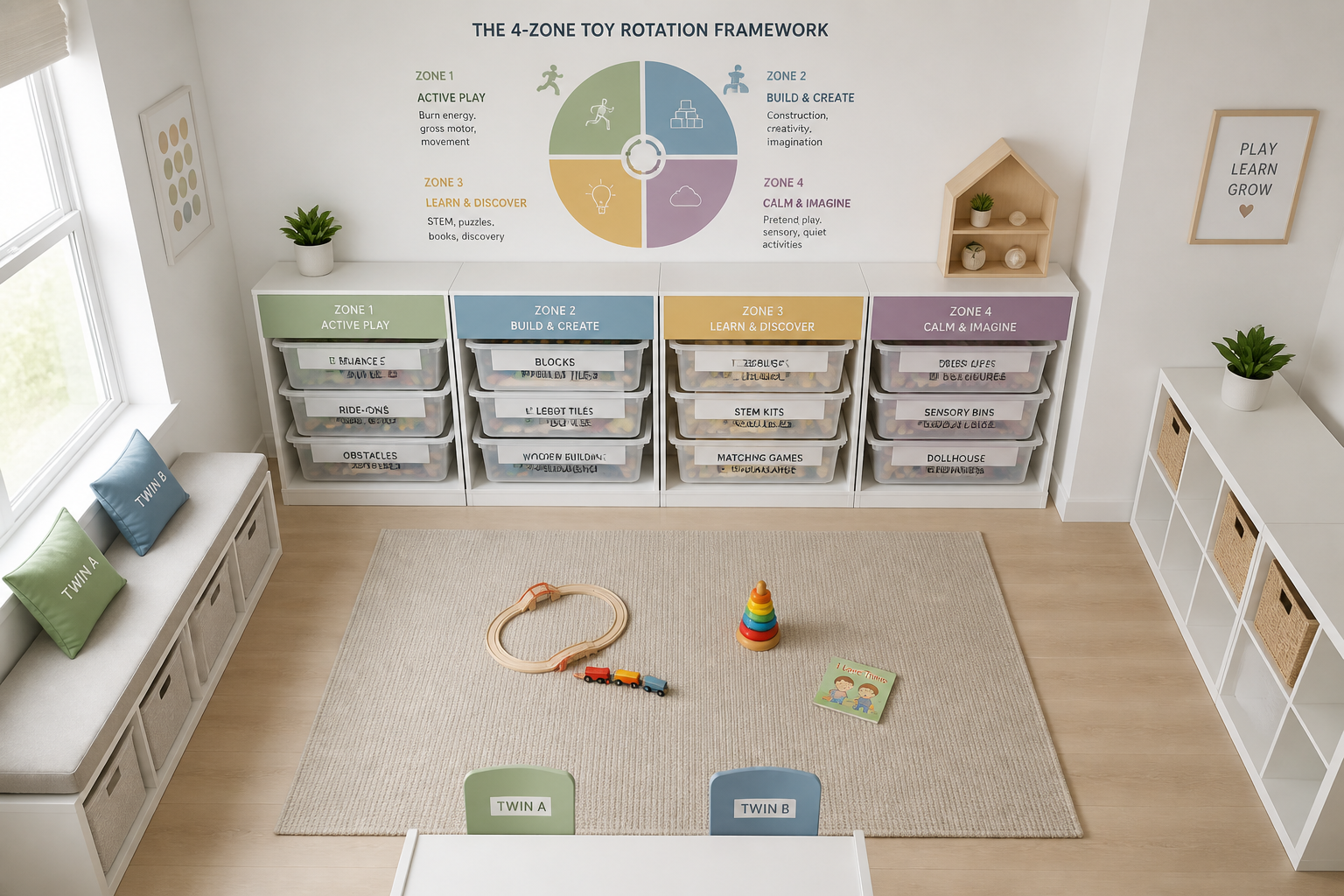
The 4-Zone Rotation Framework
Zone 1: Individual Identity Toys
Each twin gets a personal collection of 8-12 toys that never rotate. These become their “signature” items—different enough to establish individual identity, engaging enough to prevent constant sibling toy-envy.
Think divergent interests: one twin gets the fire truck collection, the other gets the farm animals. Not random selection—strategic differentiation based on observed preferences.
Zone 2: Shared Discovery Pool
This zone contains 15-20 high-engagement toys designed for parallel play. These rotate weekly, appearing fresh every rotation cycle. The key? Remove these completely between rotations. No “transition period” where toys linger—that creates chaos.
Zone 3: Duplicate Essentials
Accept reality: some toys need duplication. Building blocks, art supplies, certain sensory toys. But here’s the professional trick—buy different colors or slight variations. Same function, visual distinction. Eliminates 90% of ownership disputes.
Zone 4: Challenge & Growth Toys
Advanced toys slightly above current developmental level. These rotate monthly, staying longer to allow skill development. When twins master these, they graduate to Zone 2 for regular rotation.
| Zone | Toy Count | Rotation Frequency | Storage Method |
|---|---|---|---|
| Individual Identity | 8-12 per twin | Never | Personal cubbies |
| Shared Discovery | 15-20 total | Weekly | Clear rotation bins |
| Duplicate Essentials | 6-8 sets | Bi-weekly | Color-coded containers |
| Challenge & Growth | 3-5 total | Monthly | Special display shelf |
Managing the Duplicate Dilemma
Here’s what toy companies won’t tell you: most “duplicate” purchases are unnecessary if you understand twin play patterns. Twins often prefer parallel play over identical play. They want to do similar activities with similar—not identical—materials.
Instead of two red fire trucks, try one red fire truck and one blue ambulance. Same play pattern, different identity markers. This principle applies across categories: two different puzzles of the same difficulty, two art kits with different themes, two building sets with different color schemes.
The 2026 toy safety standards actually support this approach—manufacturers now design “twin-friendly” product lines with built-in variation specifically for multiple households.
Storage Systems That Actually Work
Forget Pinterest-perfect toy rooms with 47 matching baskets. Real twin households need storage that survives the chaos test.
The Clear Container Rule: Every rotation toy lives in a clear, labeled container. Twins need visual confirmation of what’s “theirs” versus what’s “ours” versus what’s “away for now.”
The One-Touch System: Any toy that requires more than one motion to put away won’t get put away. Period. Design storage around this reality.
The Reset Zone: Designate one area as the “toy reset zone”—a staging area where toys land before being properly sorted. This prevents the entire house from becoming one giant toy basket.
Weekly Rotation Mechanics
Sunday evening becomes “Toy Rotation Night”—a 15-minute family system that even toddler twins can participate in. Not a chore, but a weekly event they anticipate.
Step 1: Twins help collect all Zone 2 toys into the “away” bin.
Step 2: New Zone 2 toys get unveiled from storage.
Step 3: Quick scan for broken/outgrown toys that need permanent removal.
Step 4: Reset all zones to baseline organization.
The key psychological trick? Make the “away” toys disappear completely. Store rotation bins in a closet, garage, or basement—somewhere completely out of sight. “Away” means gone, not “stored on that shelf I can see from here.”
The Seasonal Purge Strategy
Every season, conduct a strategic toy audit using the “Twin Filter Test”:
1. Has either twin engaged with this toy in the past month?
2. Does this toy serve a unique function not covered by other toys?
3. Is this toy age-appropriate for current developmental stage?
4. Does this toy create more chaos than engagement?
Toys failing this test get donated immediately. No “maybe later” pile—that’s just clutter with a different name.
Smart twin families also leverage the seasonal transition to introduce new challenge toys and retire outgrown items. Natural refresh cycle that prevents accumulation without creating dramatic “toy loss” trauma.
- Twin Tactics: Pro-Level Shortcuts
- The 24-Hour Rule: When twins request a toy from the rotation bin, they must wait 24 hours. Most requests get forgotten, eliminating impulsive rotation breaking.
- The Swap Shop System: Create a designated “toy trading post” where twins can exchange items from their personal zones with each other—reduces parent intervention in ownership disputes.
- The Photo Inventory: Take pictures of each rotation setup. When twins claim “we never had that toy,” show them the photo evidence. Eliminates gaslighting and creates accountability.
- The Gradient Difficulty Strategy: Arrange challenge toys from easiest to hardest within their storage area. When twins master one level, they naturally progress to the next without parent guidance.
- The Emergency Backup Bin: Keep one container of “special circumstance” toys for sick days, rainy weather, or high-stress periods when normal rotation rules need temporary suspension.
Technology Integration
Modern toy rotation benefits from simple tracking technology. A basic smartphone app or shared digital calendar helps track rotation schedules, toy locations, and which items generate the most engagement.
Some families use QR codes on storage bins—scan the code to see what’s inside without opening containers. Particularly useful for toys with small pieces that create mess when bins get dumped for exploration.
The goal isn’t high-tech complexity, but strategic systems that reduce mental load for parents while maintaining engagement for twins.
Troubleshooting Common Rotation Failures
Problem: Twins ignore newly rotated toys
Solution: The “curiosity gap” technique—leave one intriguing new toy partially visible but not fully accessible for 24 hours before official rotation.
Problem: Constant fighting over specific toys
Solution: Implement “toy time-sharing”—disputed toys get 30-minute individual turns rather than shared access.
Problem: Toys get destroyed during transition periods
Solution: Create a “toy hospital” bin for items needing repair, making maintenance part of the rotation ritual rather than emergency response.
Problem: Rotation system gets abandoned during busy weeks
Solution: Build flexibility into the framework—missed rotations extend current setup rather than creating makeup work.
The most successful twin laundry systems and toy rotation systems share common principles: they work with family rhythms rather than against them, require minimal daily maintenance, and create natural accountability for all family members.
Remember: the goal isn’t toy perfection, it’s sustainable systems that support family life rather than dominating it. A slightly imperfect rotation system that gets used consistently beats a perfect system that gets abandoned after two weeks.
The Space-Optimization Strategy
Implement the “15-Toy Rule”: each play area should contain no more than 15 toys at any given time. This magical number provides enough variety for engagement while preventing choice paralysis and cleanup overwhelm that destroys twin cooperation.
To a more organized home, Jordan