


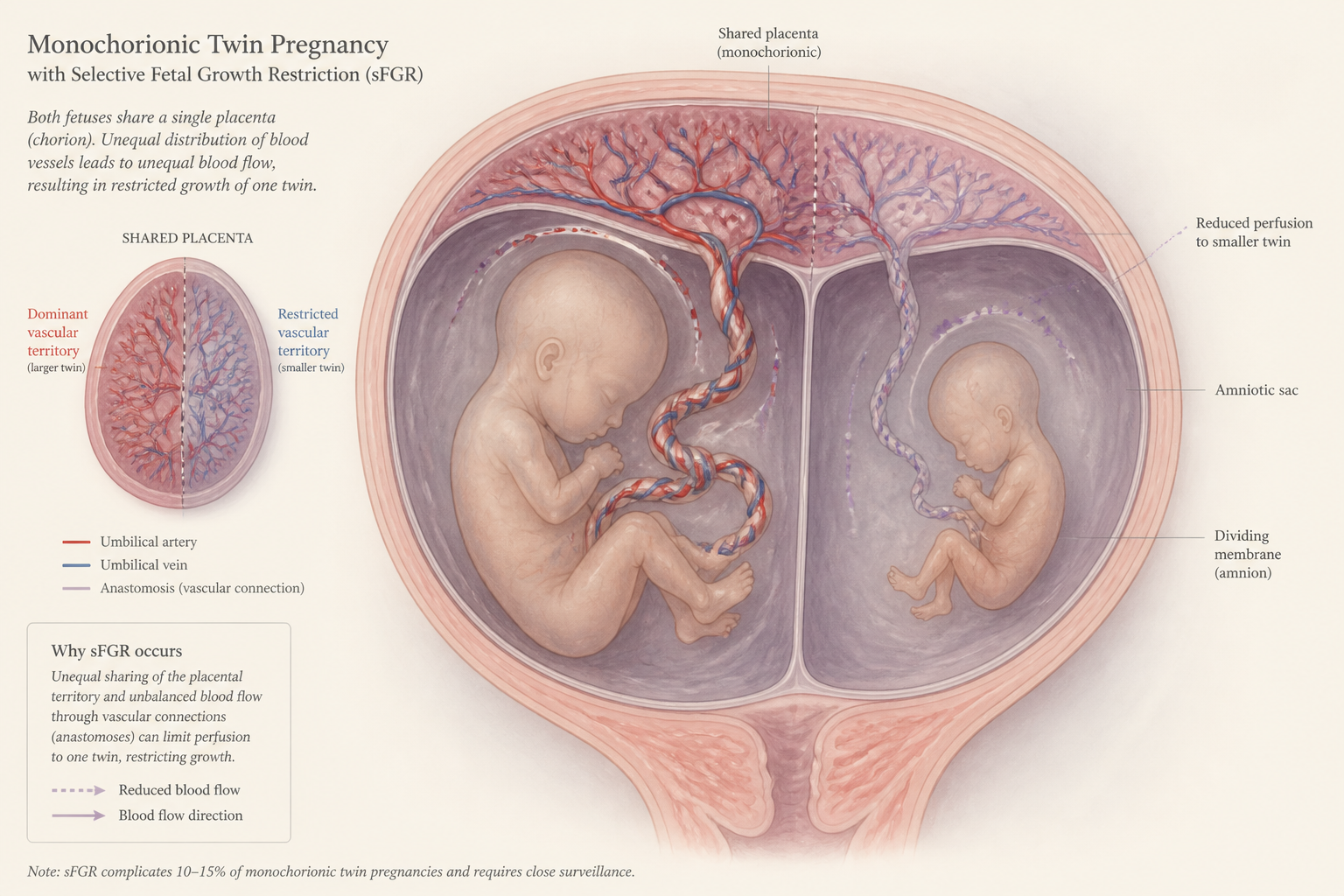
Selective Fetal Growth Restriction in Twin Pregnancy: When One Twin Falls Behind
The ultrasound screen shows two heartbeats, but the measurements tell a concerning story. Twin A measures perfectly on track at 32 weeks, while Twin B appears closer to 28 weeks gestation. This 25% weight discordance signals selective fetal growth restriction (sFGR), one of the most challenging complications in monochorionic twin pregnancies.
As a pediatrician specializing in fetal medicine, I’ve guided countless families through this complex diagnosis. sFGR occurs when unequal placental sharing restricts one twin’s growth while the co-twin develops normally. Understanding this condition becomes crucial when navigating high-risk twin delivery scenarios and their associated complications.
Understanding sFGR Twin Pregnancy: The Unequal Share
Selective fetal growth restriction affects approximately 10-15% of monochorionic pregnancies. Unlike generalized growth restriction affecting both twins, sFGR specifically impacts the smaller twin due to unequal placental territory distribution.
The condition stems from discordant placental sharing. While both twins originate from the same fertilized egg and share one placenta, the vascular territories aren’t always equal. The smaller twin receives insufficient nutrients and oxygen through a compromised placental share.
Three distinct types characterize sFGR severity:
Type I (Positive End-Diastolic Flow): The mildest form where umbilical artery Doppler studies show normal forward flow throughout the cardiac cycle. These pregnancies often continue safely to near-term delivery.
Type II (Absent/Reversed End-Diastolic Flow): More severe restriction where Doppler studies reveal compromised blood flow patterns. This type requires intensive monitoring and earlier delivery consideration.
Type III (Intermittent Absent/Reversed Flow): The most complex variant with fluctuating flow patterns, often associated with twin-twin transfusion syndrome complications.
Clinical Diagnosis and Monitoring Protocols
Early detection relies on systematic ultrasound surveillance every 2-3 weeks starting at 16 weeks gestation. Key diagnostic criteria include:
– Estimated fetal weight discordance exceeding 25%
– Smaller twin measuring below the 10th percentile for gestational age
– Abnormal umbilical artery Doppler patterns
– Oligohydramnios around the growth-restricted twin
| sFGR Type | Umbilical Artery Doppler | Perinatal Survival Rate | Management Strategy |
|---|---|---|---|
| Type I | Positive end-diastolic flow | 95-98% | Conservative monitoring |
| Type II | Absent/reversed flow | 85-90% | Intensive surveillance, early delivery |
| Type III | Intermittent abnormal flow | 70-85% | Consider cord occlusion procedures |
Advanced fetal surveillance includes middle cerebral artery Doppler studies to assess brain-sparing circulation and ductus venosus evaluation for cardiac compromise signs.
Treatment Approaches: From Conservative to Interventional
Management strategies depend on sFGR severity, gestational age, and concurrent complications like twin transfusion syndrome.
Conservative Management
Type I sFGR typically receives expectant management with:
– Bi-weekly ultrasound monitoring
– Maternal activity modification
– Enhanced nutrition counseling
– Daily fetal movement counting
– Planned delivery between 34-37 weeks
Surgical Interventions
Severe cases may require fetal surgical procedures:
Selective Laser Photocoagulation: Divides vascular connections between twins, particularly when sFGR coexists with twin-twin transfusion syndrome.
Selective Cord Occlusion: Reserved for extreme cases where continuing the pregnancy threatens both twins’ survival. This procedure intentionally stops blood flow to the severely affected twin to protect the healthier co-twin.
Amnioreduction: Addresses severe polyhydramnios around the larger twin while monitoring the growth-restricted sibling.
The 2026 fetal surgical guidelines emphasize minimally invasive techniques with improved visualization technology, reducing maternal recovery time and pregnancy complications.
Long-term Outcomes and Developmental Considerations
sFGR twin pregnancy outcomes vary significantly by severity and management timing. Type I cases generally achieve excellent outcomes with appropriate monitoring. More severe types carry increased risks for:
– Preterm delivery complications
– Neonatal intensive care requirements
– Potential neurodevelopmental differences
– Feeding difficulties in the smaller twin
Research indicates that early intervention and appropriate delivery timing optimize outcomes for both twins. The growth-restricted twin often demonstrates catch-up growth during infancy, though some size differences may persist.
Neurodevelopmental follow-up becomes particularly important. While most children develop normally, the smaller twin may show subtle differences in motor skills or learning patterns requiring early intervention services.
Twin Tactics: Pro-Level Shortcuts
– Optimize timing for serial ultrasounds: Schedule appointments every 14 days starting at 16 weeks, not the standard monthly visits that can miss rapid changes
– Track amniotic fluid changes: Sudden oligohydramnios progression often precedes acute deterioration by 5-7 days
– Monitor maternal symptoms closely: Decreased fetal movement perception often affects the smaller twin first – keep detailed movement logs
– Coordinate delivery planning early: Establish NICU availability and pediatric specialists before 28 weeks to avoid emergency transfer delays
– Document growth velocity trends: Weekly weight gain patterns predict outcomes better than single percentile measurements
Nutritional Support and Maternal Optimization
Maternal nutrition plays a crucial role in optimizing outcomes for sFGR pregnancies. While placental sharing limitations can’t be completely overcome through diet, strategic nutritional support helps maximize available resources.
Protein intake recommendations increase to 1.5-2.0 grams per kilogram of pre-pregnancy weight. High-quality protein sources support fetal growth and maternal blood volume expansion necessary for optimal placental perfusion.
Folate supplementation continues at 800-1000 micrograms daily, while iron requirements often increase due to expanded maternal blood volume. Some specialists recommend omega-3 fatty acid supplementation to support fetal brain development, particularly important for the growth-restricted twin.
Delivery Planning and Timing Considerations
Optimal delivery timing balances fetal maturity against ongoing growth restriction risks. Most sFGR pregnancies deliver between 32-37 weeks, depending on severity and progression.
Delivery indications include:
– Worsening Doppler studies suggesting imminent fetal compromise
– Maternal complications like preeclampsia
– Reaching 37 weeks gestation in stable cases
– Evidence of acute fetal distress in either twin
Cesarean delivery becomes necessary in approximately 70-80% of sFGR cases due to positioning difficulties and the need for rapid delivery access if complications arise during labor.
The Pediatrician’s Medical Survival Tip
Always request copies of your serial ultrasound reports and learn to identify the estimated fetal weight percentiles. When you understand the growth trajectory patterns yourself, you can ask more targeted questions during appointments and better advocate for appropriate monitoring frequency adjustments.
Stay healthy, Dr. Sarah


 in twin pregnancies is vital. Learn about diagnosis, types, and treatment options for sFGR twin pregnancy from a specialist.)