


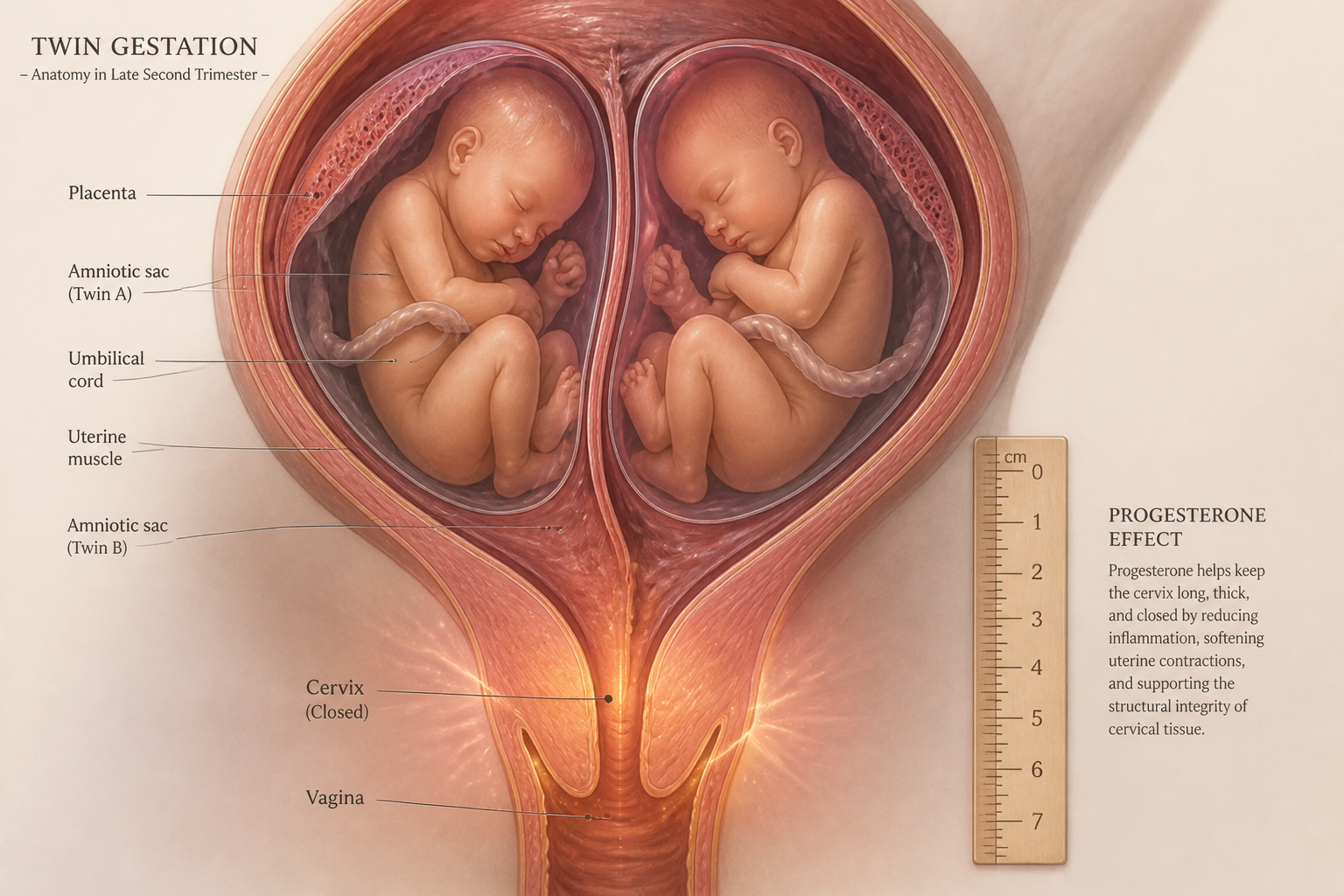
Preventing Preterm Labor in Twins: Evidence-Based Cervical Monitoring and Progesterone Protocols
At 24 weeks, Maria’s cervix measured 18mm during her routine ultrasound. Her maternal-fetal medicine specialist immediately prescribed 17-hydroxyprogesterone caproate injections and scheduled biweekly monitoring. This proactive intervention helped her carry her twins to 36 weeks—a testament to how cervical length surveillance and targeted progesterone therapy can dramatically alter outcomes in twin pregnancies.
Twin pregnancies face a 60% risk of preterm delivery before 37 weeks, making preterm labor twins prevention one of our most critical obstetric challenges. Understanding comprehensive twin birth complications and their management becomes essential when developing prevention strategies that can extend pregnancy duration and improve neonatal outcomes.
Understanding Cervical Insufficiency in Twin Pregnancies
The cervix serves as nature’s gatekeeper during pregnancy, maintaining structural integrity under increasing pressure from growing fetuses. In twin pregnancies, this pressure doubles. The additional amniotic fluid volume and combined fetal weight create mechanical stress that can trigger premature cervical shortening.
Cervical length naturally decreases throughout pregnancy, but the rate of change matters more than absolute measurements. A cervix shortening from 40mm to 30mm over four weeks signals different risk than the same measurement dropping to 25mm in two weeks.
Research from 2026 safety standards shows that cervical length below 25mm before 28 weeks increases preterm birth risk by 400% in twin pregnancies. This threshold guides our intervention protocols and monitoring frequency.
Progesterone’s Mechanism in Preterm Labor Prevention
Progesterone acts as pregnancy’s natural muscle relaxant, inhibiting uterine contractions through multiple pathways. It blocks gap junction formation between myometrial cells, preventing coordinated contractions that lead to labor onset.
17-hydroxyprogesterone caproate (17P) injections provide sustained hormone levels compared to vaginal suppositories. Weekly intramuscular injections maintain therapeutic concentrations for 7-10 days, ensuring consistent uterine quiescence.
Vaginal progesterone offers different advantages. The micronized formulation allows direct cervical tissue absorption, potentially strengthening cervical structure while providing systemic benefits. Some patients respond better to one delivery method over another.
Cervical Length Monitoring Protocols
Standard Screening Timeline
Cervical length assessment begins at 16-18 weeks in twin pregnancies. Transvaginal ultrasound provides the most accurate measurements, requiring specific technique for reliability.
The measurement protocol involves three separate readings with the probe gently inserted to visualize the entire cervical canal. We document the shortest measurement among three consistent readings, ensuring the bladder is empty to avoid compression artifacts.
| Gestational Age | Normal Cervical Length | High-Risk Threshold | Intervention Level |
|---|---|---|---|
| 16-20 weeks | 35-45mm | <30mm | <25mm |
| 20-24 weeks | 30-40mm | <25mm | <20mm |
| 24-28 weeks | 25-35mm | <20mm | <15mm |
| 28-32 weeks | 20-30mm | <15mm | <10mm |
Advanced Monitoring Techniques
Beyond simple length measurement, we assess cervical funneling—the V-shaped opening of the internal os that precedes length shortening. Funneling width and depth provide additional risk stratification data.
Dynamic assessment involves gentle fundal pressure during ultrasound to evaluate cervical response under stress. A competent cervix maintains length and closure under pressure, while an incompetent cervix shows further shortening or funneling.
Evidence-Based Progesterone Protocols
17-Hydroxyprogesterone Caproate (17P)
Weekly 250mg intramuscular injections starting between 16-20 weeks represent the gold standard for preterm labor twins prevention in high-risk patients. The oil-based suspension requires deep intramuscular injection, typically in the dorsogluteal or ventrogluteal sites.
Side effects include injection site reactions, fluid retention, and mood changes. Rotating injection sites and applying warm compresses afterward reduces local discomfort. Most patients tolerate the regimen well through 36 weeks.
Contraindications include active liver disease, hormone-sensitive cancers, and unexplained vaginal bleeding. Careful screening ensures appropriate candidate selection for this intensive intervention.
Vaginal Progesterone Suppositories
200mg vaginal progesterone suppositories provide an alternative for patients unsuitable for injections. Daily insertion at bedtime maximizes absorption and minimizes leakage during sleep hours.
The vaginal route offers convenience and patient autonomy while maintaining therapeutic effectiveness. Some studies suggest equivalent efficacy to 17P for specific patient populations, particularly those with isolated cervical shortening.
Combination Intervention Strategies
Patients with multiple risk factors often benefit from combined approaches. Cervical cerclage placement alongside progesterone therapy provides mechanical and pharmacological protection against preterm labor twins complications.
Activity modification plays a supporting role. Modified bed rest—avoiding lifting, prolonged standing, and strenuous activity—reduces mechanical stress on the compromised cervix without complete immobilization.
Managing concurrent conditions like gestational diabetes requires coordination between multiple specialists to optimize pregnancy outcomes while maintaining preterm labor prevention protocols.
Monitoring Treatment Response
Serial cervical length measurements every 2-3 weeks assess intervention effectiveness. Stable or increasing measurements indicate successful treatment, while continued shortening may require protocol adjustments or additional interventions.
Fetal fibronectin testing adds predictive value when cervical changes occur despite treatment. Negative results provide reassurance, while positive tests warrant intensified monitoring and potential delivery preparation.
Uterine activity monitoring through tocodynamometry can detect subclinical contractions that precede clinical preterm labor. Some high-risk patients benefit from home monitoring systems that alert providers to concerning patterns.
Twin Tactics: Pro-Level Shortcuts
– Schedule cervical length appointments for the same time of day to minimize measurement variability caused by daily cervical changes
– Request the same sonographer when possible—operator experience significantly affects measurement accuracy and consistency
– Track progesterone injection sites using a body diagram to ensure proper rotation and identify developing injection site complications early
– Maintain a contraction diary noting intensity, frequency, and triggers to help distinguish Braxton-Hicks from true preterm labor patterns
– Pre-medicate with acetaminophen 30 minutes before 17P injections to reduce post-injection discomfort and inflammatory response
Long-term Outcomes and Success Rates
Cervical length monitoring combined with appropriate progesterone intervention extends twin pregnancies by an average of 2.5 weeks. This seemingly modest extension dramatically improves neonatal outcomes, reducing NICU stays by 40% and severe complications by 60%.
Success rates vary by risk factors and intervention timing. Patients beginning treatment before 20 weeks with cervical length above 20mm show the best responses, with 75% delivering after 34 weeks.
Even patients with advanced cervical shortening benefit from intervention. Those starting treatment with cervical length below 15mm still show meaningful pregnancy prolongation compared to untreated controls.
The Pediatrician’s Medical Survival Tip
If your cervical length drops below 25mm, request same-day progesterone initiation rather than waiting for your next appointment—every day matters for fetal lung development, and immediate intervention can prevent rapid progression to incompetent cervix.
Stay healthy, Dr. Sarah