


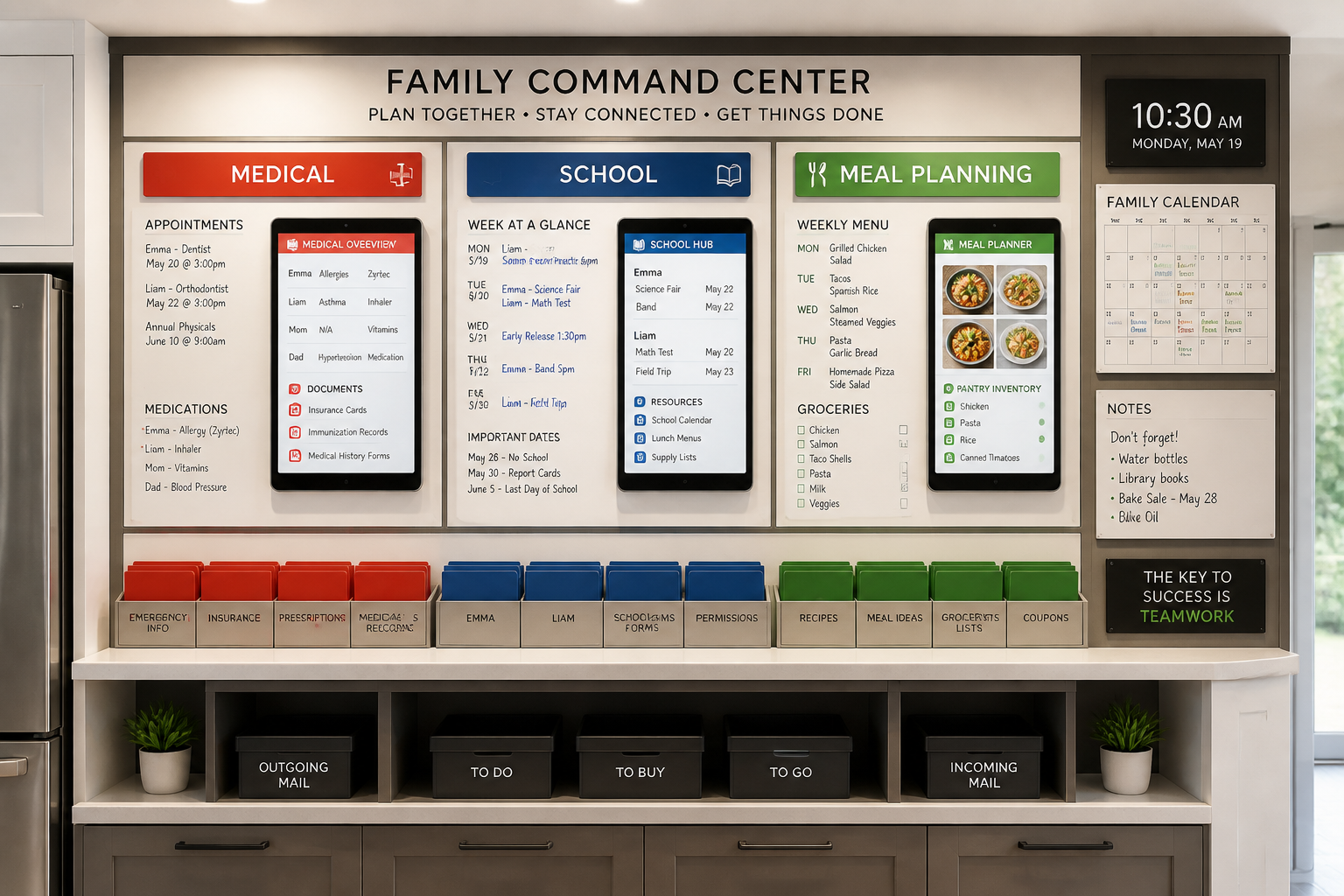
Master Your Family Command Center: The Ultimate Coordination Hub for Twin Households
The Monday morning chaos hits like clockwork: twin A needs their inhaler refill, twin B forgot their permission slip, and you’re staring at an empty fridge wondering what happened to your meal plan. Sound familiar? The difference between households that thrive and those that barely survive comes down to one thing—a strategically designed family command center twins can depend on.
After organizing hundreds of multi-child homes, I’ve learned that twin families need more than pretty bulletin boards and cute chalkboards. You need a mission-control system that anticipates the unique challenges of managing duplicate schedules, medical needs, and meal rotations. The best twin household management starts with a command center that actually commands.
The Anatomy of a High-Performance Family Command Center
Your command center isn’t decoration—it’s infrastructure. Think NASA ground control, not Pinterest inspiration board.
Zone 1: The Medical Matrix
Twins often share similar medical needs, but tracking individual requirements becomes critical as they grow. Create separate medical tracking sections using color-coded systems:
– Vaccination schedules with individual countdown timers
– Prescription refill alerts linked to pharmacy auto-fill systems
– Growth tracking charts for pediatric appointments
– Emergency contact cards with twin-specific medical information
The 2026 safety standards now recommend digital backups for all medical information, so photograph updates weekly and store in your family cloud system.
Zone 2: Academic Command Station
School coordination doubles in complexity when you’re managing two academic trajectories. Even identical twins often have different learning paces and social needs.
Academic Tracking Elements:
– Separate homework assignment boards with daily check-off systems
– Teacher communication logs (individual parent-teacher correspondence)
– Project deadlines with backward-planning timelines
– Permission slip collection station with duplicate tracking
Pro tip: Use different colored file folders for each twin’s school paperwork. This simple system prevents the dreaded “wrong twin’s field trip” scenario.
Zone 3: Nutritional Navigation Center
Meal prepping for twins requires next-level planning, especially when managing different dietary needs, preferences, or growth spurts.
Essential Meal Planning Components:
– Weekly meal rotation boards with prep-ahead indicators
– Grocery inventory tracking (because twins demolish food stores)
– Special dietary requirement alerts (allergies, sensitivities)
– Snack station restocking schedule
| Command Center Zone | Average Setup Time | Weekly Maintenance | Complexity Level |
|---|---|---|---|
| Medical Matrix | 3-4 hours | 15 minutes | High |
| Academic Command | 2-3 hours | 30 minutes | Medium |
| Nutritional Navigation | 2 hours | 45 minutes | Medium |
| Digital Integration Hub | 1-2 hours | 10 minutes | Low |
Digital Integration: Making Your Command Center Smart
Physical boards work, but smart integration transforms your family command center twins into an automated system that works even when you’re overwhelmed.
Automation Hierarchy
Level 1: Basic Sync
Connect your physical command center with shared family calendar apps. Google Calendar, Apple Family, or Cozi work well for basic coordination.
Level 2: Smart Notifications
Set up automated reminders for recurring events. Medical appointments, prescription refills, and school deadlines shouldn’t rely on your memory alone.
Level 3: Predictive Planning
Advanced systems learn your family patterns. Smart home integration can remind you about meal prep on Sundays or alert you when medical supplies run low.
Physical Layout Optimization
Location determines success. Your family command center needs prime real estate in your home’s traffic flow.
The Golden Triangle
Position your command center where three critical paths intersect:
1. Kitchen access (meal planning visibility)
2. Entry/exit routes (daily schedule confirmation)
3. Homework zones (academic coordination)
Most successful installations happen in expanded mudroom areas, large kitchen peninsulas, or converted breakfast nook spaces.
Vertical Space Maximization
Twin families need double the information density. Think vertically:
– Upper sections: Long-term planning (monthly calendars, vacation schedules)
– Eye level: Daily/weekly urgent information
– Lower sections: Child-accessible elements (chore charts, reward systems)
Twin Tactics: Pro-Level Shortcuts
- The Sunday Stack System: Dedicate 20 minutes every Sunday to review and update all three command center zones simultaneously. Set a timer and move methodically through medical updates, school prep, and meal planning.
- Color Psychology Advantage: Assign each twin a color that follows them through ALL systems—medical files, school folders, meal preferences, and digital calendars. This creates instant visual recognition across your entire organizational ecosystem.
- The 48-Hour Buffer Rule: Build two-day cushions into all critical deadlines. Permission slips due Friday get scheduled for Wednesday completion. This accounts for twin-specific chaos and prevents last-minute scrambling.
- Duplicate Documentation Strategy: Keep twin sets of emergency information in your car, at grandparents’ houses, and in your digital systems. When one twin needs urgent medical attention, you’ll have complete information for both children readily available.
- The Monthly Reset Ritual: First Sunday of each month, completely refresh your command center. Remove outdated information, update medical tracking, and reassess what’s working versus what’s creating confusion. Evolution prevents stagnation.
Maintenance Systems That Actually Work
Creating your family command center is phase one. Maintaining it requires systematic approaches that accommodate real-life twin parenting chaos.
The Daily 5-Minute Sweep
Every evening, spend five minutes updating tomorrow’s priorities across all three zones. This micro-maintenance prevents information pile-up and keeps systems current.
Weekly Deep Dive
Sunday evening, conduct a 15-minute comprehensive review:
– Update medical appointment schedules
– Confirm school project deadlines
– Adjust meal plans based on weekly grocery availability
– Sync digital systems with physical boards
Monthly Evolution Assessment
Your family’s needs change as twins grow. Monthly command center audits ensure your systems evolve with your household’s reality.
Troubleshooting Common Command Center Failures
Problem: Information overload creates visual chaos
Solution: Implement the “one in, one out” rule. Remove outdated information immediately when adding new elements.
Problem: Family members ignore the command center
Solution: Position it in an unavoidable location and create positive reinforcement loops. Successful command centers become habit-forming.
Problem: Digital and physical systems fall out of sync
Solution: Designate one family member as the “sync manager” responsible for keeping all systems current.
The most effective family command center twins will actually use combines visual accessibility with systematic maintenance. Your command center should reduce decision fatigue, not add to your daily mental load.
Remember: perfection isn’t the goal—functionality is. Start with one zone, master it, then expand. Your future self will thank you when medical emergencies, school deadlines, and meal planning happen seamlessly instead of chaotically.
The Space-Optimization Strategy
Install a magnetic whiteboard on the inside of your pantry door for emergency meal planning. When your carefully planned weekly meals go sideways (and they will), you’ll have a backup system that uses ingredients you already have on hand—turning chaos into opportunity.
To a more organized home,
Jordan