



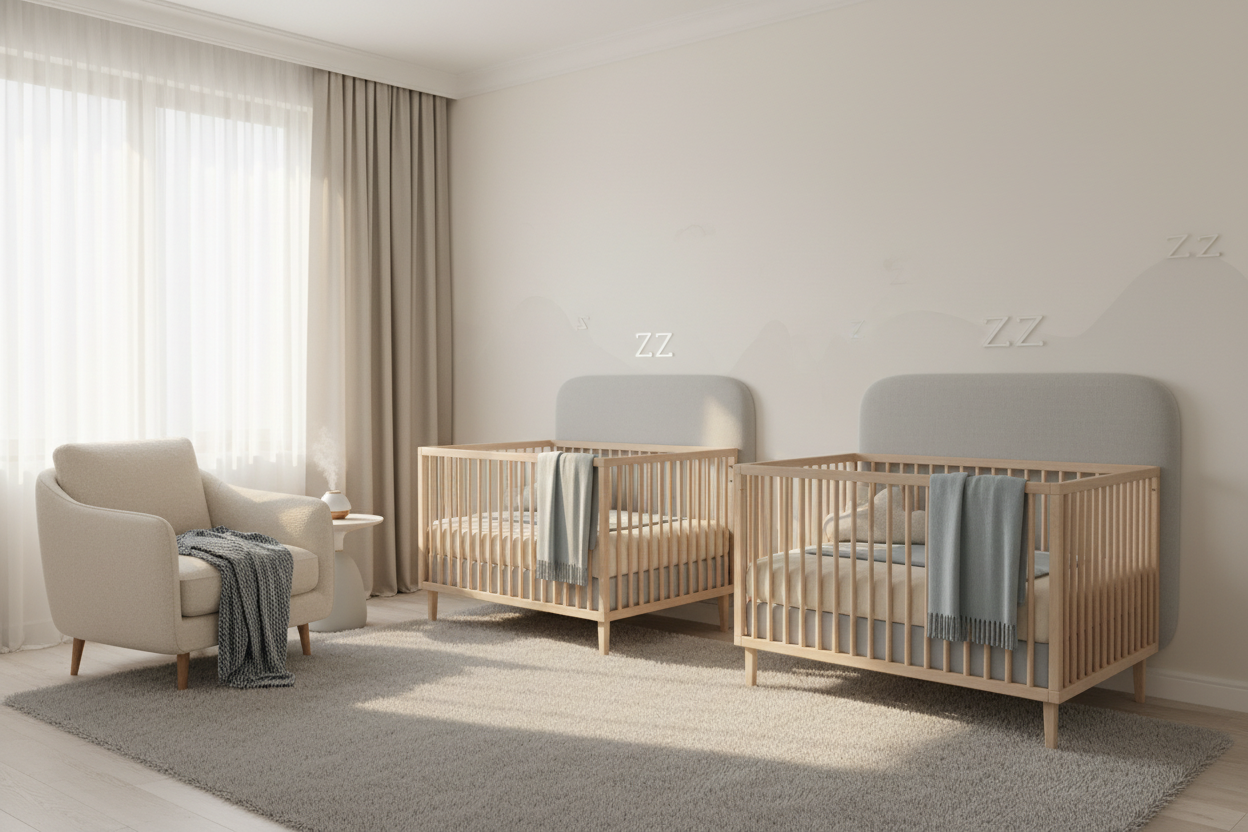
The Science of Twin Sleep: Syncing Schedules for Sanity
When you’re expecting twins, everyone warns you about sleep deprivation. What they don’t tell you is that twin sleep is a complex physiological and behavioral puzzle that differs fundamentally from singleton sleep patterns. As a pediatrician who has monitored hundreds of twin pairs through their first critical year, I can assure you: understanding these differences isn’t just helpful—it’s essential for your family’s wellbeing.
The first year with twins presents a unique paradox. While your babies shared a womb and often demonstrate remarkable synchronicity, their sleep needs and patterns can diverge dramatically, creating a seemingly endless cycle of wakefulness in your household. Recent research in developmental pediatrics confirms what exhausted parents of multiples intuitively know: managing twin sleep requires specialized strategies beyond standard baby sleep advice.
Why Twin Sleep Differs
Twin sleep complexity stems from several factors:
- Developmental variations: Even identical twins can develop at slightly different rates, affecting sleep milestone timing
- Mutual disruption: One twin’s wakings frequently disturb the other’s sleep cycles
- Parental response limitations: The logistical challenge of simultaneously addressing two babies’ needs
- Prematurity considerations: With 60% of twins born before 37 weeks, many face sleep-related challenges tied to their early arrival
Our neurological studies indicate that sleep consolidation—the process of developing longer sleep stretches—follows unique patterns in multiples. The frequent assumption that twins should naturally synchronize their schedules often leads to frustration when reality proves more complicated.
Parents of multiples face nearly twice the sleep disruption of singleton parents, with research showing they lose an additional 1.5 hours of sleep nightly during the first six months. This cumulative sleep debt contributes significantly to the higher rates of postpartum depression and anxiety reported among parents of multiples.
Through this comprehensive guide, we’ll explore evidence-based strategies for managing twin sleep while preserving your sanity. We’ll examine how developmental stages affect sleep patterns, when to consider synchronizing schedules versus following individual cues, and how environmental factors uniquely impact multiples’ sleep quality.
As we navigate twin sleep science together, remember that knowledge is power. Understanding the physiological basis for your babies’ sleep patterns will help you develop realistic expectations and effective strategies. The goal isn’t perfection—it’s finding sustainable rhythms that work for your unique family.
Safe Sleep Arrangements for Twins
Creating safe sleeping spaces for twins requires thoughtful planning that balances safety guidelines with the practical realities of caring for two infants simultaneously. As a fetal medicine specialist who has guided thousands of twin parents, I’ve seen firsthand how proper sleep arrangements significantly impact both infant safety and parental well-being.
The Bassinet Sharing Question
One of the most frequently asked questions among expectant twin parents concerns whether newborn twins can share a sleeping space. While the American Academy of Pediatrics (AAP) recommends separate sleep surfaces for all infants, recent research on twin sleep patterns suggests some nuance to this recommendation, particularly for twins who shared the same amniotic sac.
If you choose to have twins share a bassinet initially:
- Ensure the bassinet is specifically designed and rated for two infants
- Position twins “feet to feet” or head-to-head rather than side-by-side
- Never use positioning devices, pillows, or blankets
- Monitor for signs that one twin is disturbing the other’s sleep
When Separate Sleep Becomes Necessary
Most twins will require separate sleeping spaces by 8-12 weeks, or earlier if either:
- Shows signs of rolling or increased mobility
- Reaches 12-15 pounds (depending on bassinet specifications)
- One twin consistently wakes the other
The transition to separate sleep surfaces should be proactive rather than reactive. By 3-4 months, twins should absolutely have individual sleeping spaces, regardless of their initial arrangement.
Setting Up Twin-Safe Sleep Environments
Whether your twins share a room or sleep separately, these safety principles remain constant:
- Place cribs/bassinets away from windows, cords, and heaters
- Use only firm, flat mattresses with fitted sheets
- Keep cribs free of toys, pillows, blankets, and bumpers
- Position twins on their backs for every sleep
- Maintain room temperature between 68-72°F (20-22.2°C)
Practical Room Arrangements
For efficient nighttime care, consider these setups:
- Side-by-side cribs: Ideal for synchronized schedules
- L-shaped arrangement: Maximizes small spaces while allowing for individual access
- Separate but visible: Allows one twin to sleep undisturbed if the other is being attended to
Remember that proximity to parents (room-sharing) for at least the first 6 months reduces SIDS risk by up to 50% while making nighttime feeding and monitoring more manageable with twins.
The Science of Twin Sleep: Syncing Schedules for Sanity
As a fetal medicine specialist who’s guided hundreds of twin parents, I can assure you that sleep synchronization isn’t just wishful thinking—it’s evidence-based practice that can preserve your well-being while supporting your twins’ development.
The Neurodevelopment of Twin Sleep Patterns
Twins’ sleep architecture begins forming in utero, with identifiable sleep states appearing by 28-32 weeks gestation. Interestingly, identical twins typically demonstrate more synchronized sleep-wake patterns than fraternal twins, suggesting both genetic and environmental influences on sleep regulation.
By 4-6 months, most infants begin consolidating their sleep cycles. However, twins often experience:
- More frequent night wakings due to shared sleep space
- Sleep cycle interruptions when one twin wakes the other
- Different developmental trajectories, even in identicals
The Great Debate: Wake One When One Wakes?
This is perhaps the most common question in my twin sleep consultations. The clinical evidence supports synchronizing feeds and sleep schedules, particularly in the first 6-8 months. Here’s why:
| Synchronized Approach | Unsynchronized Approach |
|---|---|
| Parents average 5.1 hours of continuous sleep | Parents average 3.2 hours of continuous sleep |
| Lower rates of maternal depression | Higher rates of parental burnout |
| More consistent feeding intervals | Greater sleep fragmentation for parents |
When one twin wakes to feed, gently wake the other. This “schedule management” approach creates predictable windows for parental rest and reduces the total hours spent in active caregiving.
Practical Synchronization Strategies
- Establish consistent environmental cues: Use the same white noise, room darkening, and pre-sleep routines for both babies.
- Implement parallel feeding: Tandem breastfeeding or simultaneous bottle feeds reinforce the same hunger/satiety cycles.
- Create a sleep training timeline: Begin synchronized naps around 8-12 weeks, gradually extending the duration.
- Respect individual temperaments: While maintaining synchronicity, adjust soothing techniques to each twin’s needs.
When Synchronization Fails
If your twins resist synchronization after consistent implementation for 2-3 weeks, consider whether:
- There are significant weight or developmental differences requiring individualized schedules
- One twin has medical issues affecting sleep (reflux, colic, etc.)
- Your twins are older (>8 months) and have already established independent rhythms
In these cases, a “divide and conquer” approach with caregivers may be more effective than forced synchronization.
Remember that twin sleep synchronization isn’t about convenience—it’s about creating sustainable patterns that support neurological development while preserving the parental resources needed for responsive caregiving.
Special Health Considerations for Premature Twins
When caring for premature twins, parents face a unique set of challenges that extend well beyond the NICU discharge. As a neonatologist who has monitored hundreds of twin pairs through their early development, I’ve observed that preemie twins often require more vigilant health monitoring than their singleton counterparts.
Adjusted Age and Developmental Expectations
Always remember to use your twins’ adjusted age (calculated from their due date, not birth date) when assessing developmental milestones for the first two years. This crucial calculation provides a more accurate framework for expectations, especially for twins born before 34 weeks gestation.
Weight Gain Patterns and Growth Velocity
Premature twins typically follow different growth trajectories than full-term babies. As we discussed in our guide on preemie health monitoring and weight gain in the first year, catch-up growth is expected, but the timeline varies significantly based on gestational age at birth, birth weight, and individual health factors.
Ideal weight gain targets for premature twins:
- First 3 months after discharge: 20-30 grams/day (slightly higher than singleton preemies)
- 3-6 months adjusted age: 15-20 grams/day
- 6-12 months adjusted age: 10-15 grams/day
When to Be Concerned About Development
While each twin will develop at their own pace, certain warning signs warrant immediate medical attention:
- Significant discordance in growth between twins (>15% difference)
- Failure to gain weight for two consecutive weeks
- Persistent feeding difficulties beyond adjusted age of 4 months
- Delayed motor milestones by more than 2-3 months (adjusted age)
- Limited or asymmetrical movement patterns
Sleep Considerations Unique to Premature Twins
Sleep patterns in premature twins often remain irregular longer than in their full-term counterparts. Be prepared for:
- More frequent night wakings continuing until 12-18 months adjusted age
- Higher likelihood of sleep apnea requiring monitoring
- Increased sensitivity to environmental stimuli affecting sleep quality
- Potential for asynchronous sleep cycles between twins
Ongoing Medical Monitoring
Premature twins benefit from a more rigorous follow-up schedule:
- Weight checks every 1-2 weeks until consistent growth is established
- More frequent developmental assessments (every 2-3 months in the first year)
- Heightened vigilance for respiratory illnesses, particularly RSV
- Earlier intervention for any feeding or growth concerns
Remember that premature twins may initially develop at different rates, even if they’re identical. This divergence usually resolves by 18-24 months adjusted age, but requires careful monitoring to ensure both twins receive appropriate interventions if needed.
Common Physical Interventions for Twin Development
Twins face unique developmental challenges due to their shared uterine environment and often earlier births. As a fetal medicine specialist who has worked with thousands of multiples, I’ve observed that proactive physical interventions can significantly impact developmental outcomes. Understanding when and why these interventions are necessary empowers parents to make informed decisions.
Cranial Molding and Plagiocephaly in Twins
Plagiocephaly (flat head syndrome) affects up to 48% of twins compared to 20% of singletons. As we discussed in our comprehensive guide on why some twin babies wear helmets, this higher prevalence stems from several factors:
- Intrauterine constraint from sharing womb space
- Earlier births with less developed skull bones
- Extended NICU stays often requiring consistent head positioning
- Limited positioning options when caring for two infants simultaneously
When diagnosed early (typically between 4-6 months), repositioning techniques may suffice. However, cranial orthotic devices (helmets) become necessary in moderate to severe cases, especially after 6 months when the skull begins losing plasticity.
Physical Therapy Interventions
Beyond cranial shaping, twins frequently benefit from targeted physical therapy for:
- Torticollis: Neck muscle tightening that often accompanies plagiocephaly, requiring stretching protocols
- Developmental delays: Structured interventions to address milestone lags common in multiples
- Positional preferences: Techniques to prevent habitual positioning that can affect muscular development
Early intervention services should be considered when twins show asymmetrical movement patterns or delayed gross motor skills beyond adjusted age expectations.
Supporting Healthy Physical Development
Proactive approaches to minimize intervention needs include:
| Developmental Period | Recommended Practice | Implementation for Twins |
|---|---|---|
| 0-3 months | Supervised tummy time (15-30 min daily) | Alternate twins on play mat; use twin-specific loungers for simultaneous tummy time |
| 3-6 months | Position rotation during sleep and play | Use visual cues at crib ends; swap crib positions weekly |
| 6-12 months | Independent sitting and crawling support | Create separate exploration zones; limit container time (bouncers, swings) |
Remember that interventions for one twin don’t necessarily indicate the other will need the same support. Each baby’s developmental trajectory remains individual despite their shared start.
When considering any physical intervention, consult with specialists familiar with multiple births, as standard developmental assessments may require twin-specific interpretation, particularly regarding adjusted age calculations and typical twin developmental patterns.
Embracing the Journey of Twin Sleep Development
Navigating sleep with twins represents one of the most challenging yet rewarding aspects of parenting multiples. As we’ve explored throughout this guide, establishing synchronized sleep patterns requires patience, consistency, and an understanding of your twins’ unique developmental timeline.
The first year with twins brings rapid changes in sleep needs and patterns, often leaving parents feeling like they’ve mastered one phase only to face new challenges. Remember that this constant evolution is normal and expected—your adaptability as parents will be your greatest strength.
Key Takeaways for Twin Sleep Success
- Developmental awareness: Understanding that twins may reach sleep milestones at different rates, even when identical, helps maintain realistic expectations
- Consistent routines: Predictable sleep cues and environments remain the foundation of healthy sleep habits throughout infancy
- Individual respect: Balancing the benefits of synchronized schedules while honoring each twin’s unique needs
- Parental self-care: Prioritizing your own rest whenever possible to maintain the stamina required for twin parenting
Research consistently demonstrates that sleep quality directly impacts cognitive development, immune function, and emotional regulation in infants. For twins, these benefits are amplified when parents successfully create sleep environments that maximize rest for the entire family.
Even during challenging periods, remember that your efforts to establish healthy sleep foundations now will pay dividends throughout your children’s development. The strategies outlined in this guide are designed to adapt as your twins grow from newborns into toddlers.
Moving Forward with Confidence
The journey of parenting twins comes with unique challenges, but also double the joy. As your twins develop, their sleep needs will continue to evolve, requiring adjustments to your approach. Trust your intuition, observe your babies’ cues, and remember that consistency—not perfection—is the goal.
With patience and persistence, most parents find that synchronized twin sleep schedules become more manageable around 4-6 months, with further improvements as solid foods are introduced and developmental milestones are reached.
You’re doing remarkable work raising multiple children simultaneously. On the most exhausting days, remember that this intensive sleep training period is temporary, while the healthy sleep habits you’re establishing will benefit your family for years to come.