


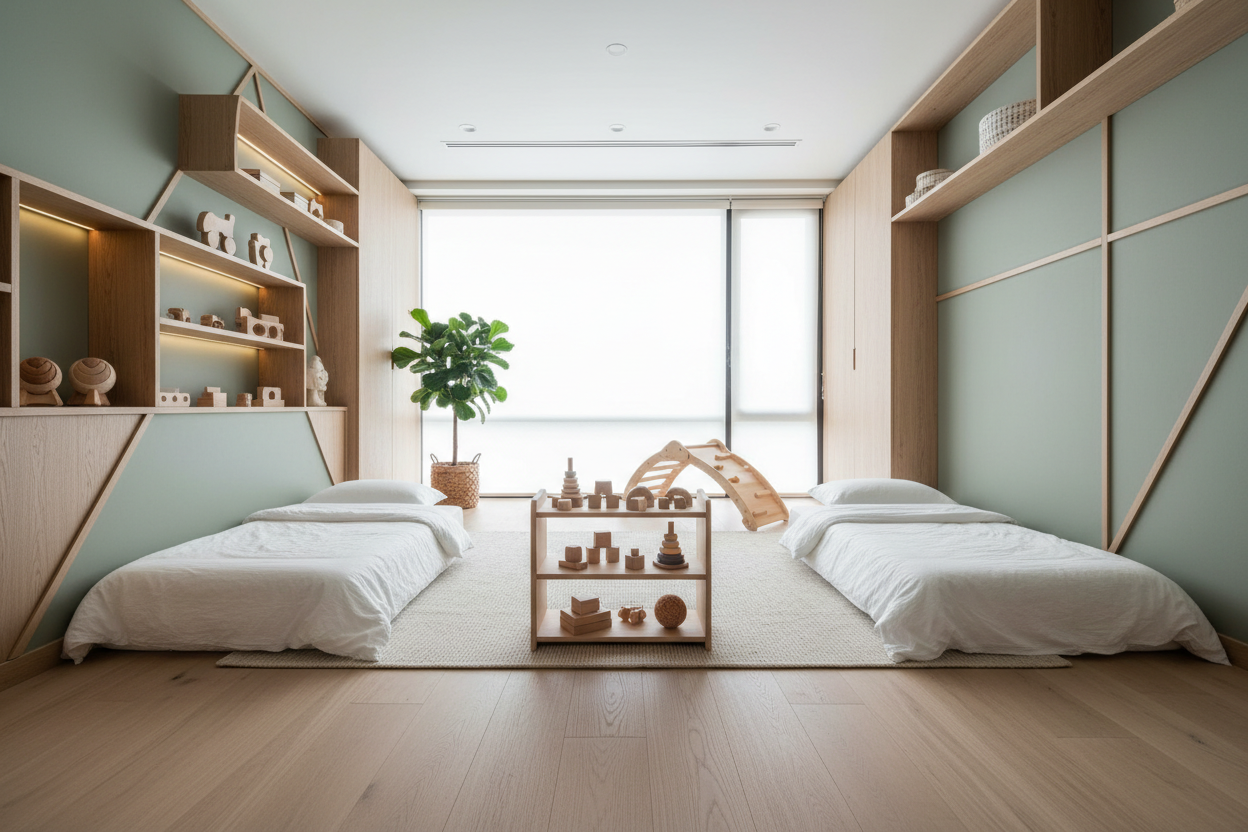
The Montessori Twin Nursery: Freedom Within Limits for Double the Independence
I just finished transforming the Mendez family’s chaotic twin nursery into a Montessori haven. Watching 14-month-old twins Eva and Leo confidently navigate their new environment—each retrieving their own cups from low shelves and settling into their floor beds without assistance—was the perfect reminder that independence isn’t just possible with twins; it’s essential.
Creating a Montessori-inspired environment for twins presents unique challenges, but the payoff is extraordinary: two children developing autonomy simultaneously while respecting each other’s space. Whether you’re expecting twins or looking to transition your current twin feeding station and sleep setup to better support independence, this guide will help you implement true Montessori principles for multiples.
Core Principles of a Montessori Twin Nursery
Montessori spaces for twins don’t just double everything—they thoughtfully balance individual development with shared experiences. The foundation remains:
– Accessibility: Everything at child height
– Freedom of movement: Unrestrictive environments
– Order: A place for everything, clearly defined
– Beauty and simplicity: Curated, natural materials
– Respect for the child: Environments that communicate trust
The twin-specific challenge? Creating distinct spaces that allow for personal development while acknowledging twins’ natural tendency to interact constantly.
The Physical Layout: Zoning for Two
The most successful montessori twins nursery layouts I’ve designed employ thoughtful zoning strategies that balance togetherness with individual development.
Sleep Zones: Floor Beds for Two
Montessori floor beds remain ideal for twins, even in shared spaces. The 2026 safety standards now specifically address twin floor bed setups, recommending:
| Floor Bed Configuration | Minimum Spacing | Benefits | Challenges |
|---|---|---|---|
| Side-by-side (parallel) | 24 inches between mattresses | Maximizes wall space, creates visual connection | Twins may disturb each other during sleep transitions |
| Opposite walls (facing) | 5 feet between mattress edges | Creates distinct territories, reduces disturbances | Requires larger room dimensions |
| L-shaped configuration | 30 inches at closest point | Balances proximity with separation, works in square rooms | Creates a “preferred” bed (corner position) |
I typically recommend the L-shaped configuration for nurseries under 140 square feet. For visual separation, consider low shelving units (max 24″ height) between mattresses.
Movement Zones: Double the Exploration
Reserve the room’s center for gross motor development. Rather than duplicating equipment, select pieces that:
1. Accommodate simultaneous use (wider climbers)
2. Offer multiple entry/exit points to prevent bottlenecks
3. Can be reconfigured as skills advance
The VIKA climbing system (newly redesigned for 2026) features twin-specific modifications that allow for parallel play without constant collisions.
Activity Zones: Shared and Individual Spaces
Create clearly defined individual and shared work areas:
– Two separate low shelves with identical core activities
– One shared shelf with materials designed for cooperation
– Personal baskets in distinct colors for storing individual work
Materials and Organization Systems
The key to a harmonious montessori twins nursery is organization systems that twins can maintain themselves.
Visual Ownership Cues
While avoiding stereotypical color coding, provide visual ownership indicators:
– Silhouette labels showing which twin each item belongs to
– Consistent placement (left side/right side orientation)
– Distinct—but equally appealing—patterns on personal items
Material Selection and Rotation
Twins benefit from both identical and complementary materials:
– Phase 1 (0-6 months): Identical core materials prevent conflicts
– Phase 2 (6-12 months): Introduce complementary materials that can be used together
– Phase 3 (12+ months): Begin implementing rotation systems with some unique materials to foster individual interests
Twin Tactics: Pro-Level Shortcuts
- The “Double Pause” Method: When entering the nursery, pause 10 seconds before intervening in any situation. Then pause 10 more seconds. You’ll be amazed how often twins resolve their own spatial conflicts.
- The “Mirror Station” Setup: Position identical activity centers on opposite sides of the room, allowing twins to work “together but apart.”
- Boundary Teaching: Use painter’s tape floor markers to create visual work spaces that twins learn to respect.
- The “One-In, One-Out” System: Implement a materials management approach where twins must return one material before selecting another.
- Progressive Property Concepts: Begin with everything shared, then gradually introduce the concept of “waiting turns” around 10-12 months, followed by personal ownership around 15-18 months.
Managing Twin-Specific Challenges
The Imitation Cycle
Twins naturally copy each other—which can either accelerate or impede development. The key is creating enough space between work areas that imitation becomes a choice rather than the default.
The Independence Paradox
Sometimes one twin develops independence faster, potentially hindering the other’s progress. Schedule brief periods of 1:1 time daily (even 10 minutes helps) to support individual development trajectories.
Material Conflict Resolution
Rather than adult-imposed sharing systems, create environmental supports for natural conflict resolution:
1. Duplicate high-interest materials during sensitive periods
2. Provide timers twins can operate themselves
3. Create clear visual cues for turn-taking
Evolving the Space: Birth to Three Years
A truly successful montessori twins nursery evolves with your children:
Newborn Phase (0-6 months)
Focus on simple, high-contrast visual mobiles positioned where both babies can benefit. Floor time spaces should be adjacent but separate to prevent accidental interference.
Mobile Phase (6-12 months)
Transition to low, stable furniture that supports pulling up. Create clear crawling pathways with no dead ends that could trap a twin with another approaching.
Walking Phase (12-24 months)
This is when true Montessori independence blossoms. Implement practical life stations with two sets of everything, positioned to encourage natural flow between activities.
Language Explosion Phase (24-36 months)
As language develops, introduce materials that support cooperative play and communication. Create small spaces where twins can work together on a puzzle or building project.
The Space-Optimization Strategy
When designing a Montessori environment for twins, follow the “3-2-1 Rule”: provide 3 distinct activity areas, 2 identical sets of essential materials, and 1 clear visual system for identifying personal vs. shared items. This prevents most twin conflicts while maximizing independence.
To a more organized home,
Jordan