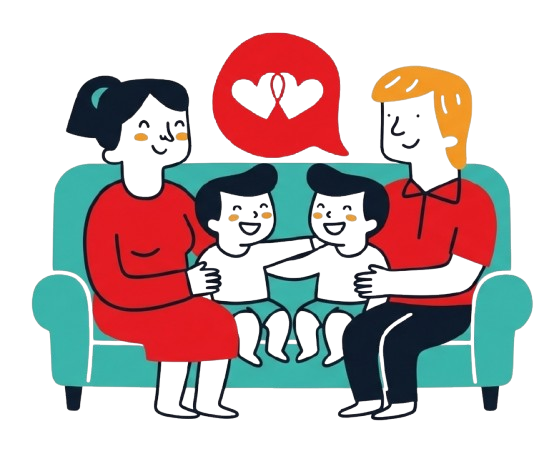



The Twin Parent Survival Handbook: First 90 Days
Holy sleep deprivation, Batman! If you’re reading this, you’ve either just discovered you’re having twins, recently brought home two squirming bundles of joy, or you’re frantically Googling at 3 AM while simultaneously bottle-feeding two babies who’ve conspired to never sleep at the same time. Welcome to the club nobody actively signs up for but everyone secretly brags about!
I’m Mark, and alongside my better half Jen (who’s currently wrestling two toddlers into matching outfits against their will), we’ve been through the twin trenches. What we’re about to share isn’t the sanitized, Instagram-filtered version of twin parenting—it’s the “there’s spit-up in my hair for the third day running and I might have put diaper cream on my face instead of moisturizer” reality that no one warns you about.
Why This Guide Exists (Besides Keeping Us Sane)
The first 90 days with twins redefine what you thought was possible—both in terms of sleep deprivation and in how much your heart can expand. This comprehensive survival handbook came from our own desperate need for realistic guidance when we were drowning in double the diapers, double the crying, and somehow triple the laundry.
Between the two of us, we’ve logged roughly 3,700 hours of twin-specific research, survived approximately 2,190 diaper changes in those first three months, and developed biceps that would make a CrossFit enthusiast jealous—all from the simple act of carrying two car seats simultaneously.
What You’ll Find Inside (Besides Our Blood, Sweat, and Tears)
This isn’t just another baby book. This is twin-specific battle planning that covers everything from the moment you see two heartbeats on that ultrasound screen to navigating the logistics of getting two three-month-olds out of the house without requiring therapy afterward.
- Practical systems for feeding, sleeping, and maintaining your sanity
- Gear recommendations that won’t require a second mortgage
- Solutions for the unique challenges only twin parents understand
- Strategies for preserving your relationship when you’re both zombies
- Real talk about recovery—because pushing out/making room for two humans is no joke
Remember, the same parents who look like they have it all together are probably hiding in the pantry eating cold spaghetti straight from the container while scrolling through photos of when they had free time. None of us have it figured out—we’re just better or worse at faking it.
So grab whatever caffeinated beverage keeps you vertical, find that 10-minute window when both babies are miraculously quiet, and let’s dive into the beautiful chaos that is the first 90 days of twin parenthood. You’ve got this. And when you don’t, we’ve got you.
Twin Genetics: Facts vs. Myths
When Mark and I found out we were having twins, my mother-in-law immediately declared, “I knew it! Twins run in our family!” Meanwhile, my side insisted twins “skip generations,” which is why they were “due” to appear. Suddenly, everyone was a genetics expert. Sound familiar?
The “Skip a Generation” Myth
Let’s address the elephant in the room: do twins really skip a generation? Scientifically speaking—no. This is perhaps the most persistent twin myth we encounter. Twin genetics don’t operate on some magical generational timer. As we explored in our deep-dive on this topic, inheritance patterns are far more complex than family lore suggests.
Twin Types & Their Genetic Foundations
Before debunking more myths, let’s clarify the basics:
- Identical twins (monozygotic): Result from one fertilized egg splitting into two embryos. These occur randomly and aren’t generally hereditary.
- Fraternal twins (dizygotic): Develop from two separate eggs fertilized by different sperm cells. These can have a genetic component—specifically on the mother’s side.
Genetic Realities Worth Knowing
Here’s what science actually tells us about twin genetics:
- A woman whose mother or sister had fraternal twins has approximately twice the chance of having fraternal twins herself.
- The “twin gene” is really about hyperovulation—releasing multiple eggs during ovulation.
- Dad’s genetics don’t directly influence twin conception (sorry, Mark), but men can pass hyperovulation genes to their daughters.
- Identical twins remain largely random events without strong genetic links.
- Maternal age (over 35) increases the likelihood of fraternal twins due to hormonal changes.
Cultural Variations in Twin Rates
When we attended our first twins playgroup, we noticed something interesting: certain ethnicities seemed overrepresented. This wasn’t our imagination:
| Population Group | Twin Birth Rate (per 1,000 births) | Notable Factors |
|---|---|---|
| Central African countries | 18-30 | Highest global rate, likely genetic factors |
| European descent | 9-16 | Rates increased with reproductive treatments |
| Asian countries | 6-9 | Consistently lowest global rates |
Modern Factors Affecting Twin Rates
While we’re focused on genetics, it’s worth noting that today’s twin boom isn’t all about family trees:
- Fertility treatments dramatically increase twin likelihood
- Delayed childbearing (more mothers over 35) naturally increases twin rates
- Improved maternal nutrition may influence twinning rates
The next time a well-meaning relative insists your twins were “destined” because Great-Aunt Mildred had twins, you can smile knowingly. Twin genetics are fascinating, but rarely follow the simple patterns family mythology suggests. And honestly, after surviving the first three months with twins, you’ll be too tired to care about the genetic origins anyway—you’ll just be wondering why nobody warned you about the synchronized midnight screaming sessions!
Critical Milestones in Twin Pregnancy
Ah, the twin pregnancy journey—twice the babies, twice the milestones, and somehow four times the doctor appointments! While every pregnancy has its checkpoints, twin pregnancies come with their own special roadmap that’ll have you waddling to your OB’s office so frequently you might as well set up a cot in the waiting room.
First Trimester: The “Wait, There’s TWO?” Phase
The first major milestone typically happens around 6-8 weeks when that ultrasound technician gets suspiciously quiet, then says those life-changing words: “I’m seeing two heartbeats.” Cue the simultaneous joy and panic! This early detection is crucial because twin pregnancies require more monitoring from the get-go.
Around 10-12 weeks, your doctor will likely start discussing your twins’ chorionicity (whether they share a placenta) and amnionicity (whether they share an amniotic sac). Don’t worry if these words sound like something from a sci-fi movie—we still stumble over them after raising our own twins.
Second Trimester: The Halfway Point That Isn’t Quite Halfway
The 20-week mark deserves special attention in twin pregnancies. While singleton moms celebrate being “halfway there,” twin mamas are looking at a different timeline altogether. As we explained in our guide on surviving the half-baked 20-week milestone, twins often arrive between 35-37 weeks, making 20 weeks more like the two-thirds mark!
This anatomy scan is extra special with twins—it’s often when you can confirm their genders (if you want to know) and get a detailed look at their development. It’s also when many twin parents start hearing terms like “growth discordance” as doctors track whether both babies are growing at similar rates.
Third Trimester: The “How Much Bigger Can I Actually Get?” Weeks
By 28 weeks, you’ll be entering the monitoring marathon. Expect biweekly or even weekly appointments as your healthcare team tracks:
- Individual baby growth patterns
- Cervical length (to watch for preterm labor)
- Signs of twin-specific complications like Twin-to-Twin Transfusion Syndrome in identical twins
The 32-week mark is particularly significant—this is when many doctors start doing non-stress tests and biophysical profiles. Your twins’ movements and heart rates will be monitored closely, and you’ll become intimately familiar with those monitoring belts that never seem to stay where they’re supposed to.
The Home Stretch: 34 Weeks and Beyond
Every week past 34 is a victory lap! This is when your doctor might discuss delivery plans in detail. Depending on your twins’ positions, health factors, and your own medical history, you could be looking at either a scheduled C-section or a vaginal delivery attempt.
Remember that while singleton pregnancies aim for 40 weeks, full-term for twins is considered 37-38 weeks. Many doctors won’t let twin pregnancies continue beyond 38 weeks, even if you’re feeling like you could waddle along indefinitely (trust us, you won’t want to!).
And the final milestone? When those two little screamers make their grand entrance, and suddenly all those extra appointments, the twin-sized belly, and those bizarre twin pregnancy symptoms become absolutely worth it.
Surviving the Newborn Phase with Twins
Welcome to what we lovingly call “Twin Twilight Zone” – those first 90 days where time loses all meaning and you might forget your own name, but somehow remember which baby last pooped. We’re Mark & Jen, and we’ve been through this battlefield. Let’s get real about surviving twin newborns.
The Feed-Sleep-Cry Cycle (Times Two)
Remember when people said, “Sleep when the baby sleeps”? Yeah, that’s adorable. With twins, it’s more like “Sleep when both babies, the dog, your phone, and the neighbor’s leaf blower are all miraculously silent.”
Our hard-earned feeding wisdom:
- Synchronize when possible – If one baby wakes to feed, wake the other. Yes, it feels criminal, but letting them set different schedules is the path to madness.
- Track everything – Use an app or notebook to record feedings, diapers, and sleep. Your sleep-deprived brain will thank you when the pediatrician asks which twin had the green poop.
- Accept help with feeding – Whether you’re breastfeeding, formula-feeding, or combo-feeding, having someone handle one baby while you feed the other is sanity-saving.
Sleep: The New Currency
We won’t sugarcoat it: sleep deprivation with twins is next-level. It’s like your body is participating in some secret military experiment.
- Sleep shifts – One parent takes 10pm-3am, the other takes 3am-8am. It’s not perfect, but five consecutive hours feels like a luxury spa retreat.
- Twin-specific sleep gear – Consider twin-specific bassinets or safe sleep solutions that let babies sleep close to each other (they’ve been roommates for months already).
- Lower your standards – If both babies are asleep at the same time, do not, under any circumstances, do housework. Sleep. Or stare blankly at a wall. Both are acceptable.
The Self-Care Survival Guide
The oxygen mask theory applies: you must take care of yourself to care for those babies. But with twins, self-care looks different:
- Micro self-care – A hot 3-minute shower, eating with both hands, or brushing your teeth before 4pm all count as victories.
- The visitor rule – Anyone who wants to visit must either bring food or hold a baby while you shower/nap/cry in the pantry eating chocolate.
- Lower expectations – Your house will be messy. You might wear the same shirt for days. The babies just need to be fed, clean, and loved—everything else is bonus points.
When You Feel Like You’re Failing
There will be moments—possibly daily—when you feel completely overwhelmed. We’ve been there. Jen once found herself sobbing in the nursery at 3am with two screaming babies, wearing a nursing bra backwards and wondering if she’d ever sleep again.
Remember: the hardest phase is temporary. Twin parents are the special forces of parenting. What feels impossible now will become your normal, and then one day, it gets easier. You’re not failing; you’re surviving an extreme sport.
And when all else fails, remember our twin parent mantra: “Two babies, two parents—we’re evenly matched.”
Navigating Twin Toddlerhood
Remember those early days when your twins would just lie there, looking adorable? Yeah, those days are long gone. Welcome to twin toddlerhood—where one child throwing spaghetti at the wall is cute, but two doing it simultaneously is basically a food fight at the UN.
Double the Tantrums, Double the… Fun?
Let’s talk tantrums. With twins, they’re like popcorn—once one starts popping, the other follows. We’ve had days where Jen was hiding in the pantry eating stale goldfish crackers while both kids were on the floor because one got the blue cup and the other wanted the EXACT SAME blue cup. Not a different blue cup. THE blue cup.
As we discussed in our guide on managing double toddler tantrums in public, having a strategic plan is crucial. Mark’s personal favorite technique? The “divide and physically remove” method. One parent, one twin, separate locations. Sometimes you just need to divide and conquer.
Encouraging Individual Development (While They Share Everything)
Twins share everything—your womb, birthday, and probably 90% of their possessions. But helping them develop as individuals is crucial. Some approaches that worked for us:
- One-on-one time: Even 15 minutes of individual attention makes a huge difference
- Different activities: Let Twin A try soccer while Twin B explores music
- Separate playdates: Terrifying at first, but incredibly valuable for independent social development
Your Sanity Preservation Plan
Remember when people said, “Sleep when the baby sleeps”? With twins, it’s more like “Survive when the babies survive.” Here’s our hard-earned wisdom:
- Lower your standards: Clean house OR sanity. Choose one.
- Tag team parenting: “You take the screamer on the right, I’ll take the one covered in yogurt”
- Find twin-friendly spaces: Places with contained play areas where double trouble can be managed
- Build your twin parent network: Only another twin parent truly understands why you’re wearing two different shoes and haven’t washed your hair in a week
The toddler phase with twins is like running a marathon where someone keeps moving the finish line. Some days, success is simply everyone being alive at bedtime. Other days, you’ll marvel at these two little humans who are developing their own friendship, complete with secret languages and conspiracies to raid the snack cabinet.
Our best advice? Laugh when you can, cry when you need to, and remember—this phase too shall pass. And then comes preschool. God help us all.
You’ve Got This: Embracing the Twin Parent Journey
Congratulations! If you’ve made it this far, you’ve either survived your first 90 days with twins or you’re strategically preparing for the beautiful chaos ahead. Either way, we’re raising our coffee mugs (filled with whatever keeps you functioning) in your honor.
The twin parent journey is unlike any other—twice the love, twice the laundry, and approximately 437 times the questions from strangers at the grocery store. But as we’ve walked through each stage of these critical first months, remember this: the challenges are temporary, but the bond you’re building is forever.
Your Survival Highlights Reel
Let’s recap what we’ve covered in your crash course to twin parenthood:
- Hospital to Home Transition: You learned to function on minimal sleep while mastering the art of dual-feeding and convincing yourself that zombie-chic is a legitimate fashion choice.
- Establishing Routines: You discovered that synchronized napping is worth celebrating more enthusiastically than your college graduation.
- Managing Support: You’ve become skilled at delegating tasks and accepting help without feeling guilty (or at least working on it).
- Self-Care: You now understand that taking care of yourself isn’t selfish—it’s essential maintenance for the family’s most important piece of equipment: YOU.
The Road Ahead
As your twins grow beyond these first 90 days, new challenges will emerge. There will be days when you feel like you’ve finally figured it out, followed immediately by days when both babies decide to rewrite all the rules.
But here’s what we know for sure: your capacity to love, adapt, and persevere will grow alongside your babies. The parent who emerges from this intensive training period will be stronger than you ever imagined possible.
When in doubt, remember our twin parent mantra: “This is hard, but I am harder.” (And yes, feel free to mumble this to yourself while hiding in the pantry eating cookies at 2 AM—we’ve all been there.)
Your Twin Community Awaits
Remember that you’re not alone on this journey. The twin parent community is unlike any other—we understand each other in ways that others simply can’t. We know the unique joy of watching two babies develop their own special language, and we understand why you might cry when someone offers to hold both babies so you can eat a meal with two hands.
We hope this handbook serves as both a practical guide and a reminder that thousands of parents have walked this path before you—and we’re all cheering you on.
Now go forth and continue being the incredible twin parent you are. Your babies don’t need perfection; they just need you—exactly as you are.
With twin-tested solidarity,
Mark & Jen