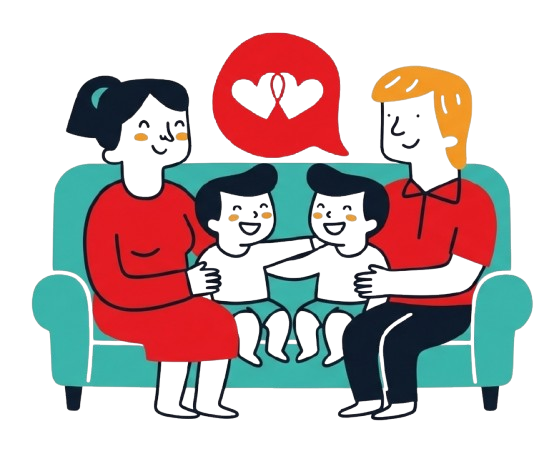



Surviving the Double Meltdown: A Field Guide to Managing Twin Toddlers in Public
Last Tuesday at the grocery store, our twins decided to simultaneously collapse onto the floor screaming because we wouldn’t let them “drive” the shopping cart into a display of precariously stacked watermelons. As fellow shoppers stared (some with pity, others with judgment), Jen looked at me and whispered, “This is why we need a comprehensive guide on twins’ behavioral patterns to show these people.” And thus, this battle plan was born.
When Double Trouble Goes Nuclear: Understanding the Twin Tantrum Dynamic
Twin tantrums aren’t just double the volume—they’re exponentially more complex. Unlike singleton parents who only manage one meltdown at a time, we’re handling synchronized emotional warfare. Managing twin toddlers in public requires military-grade strategy because they feed off each other’s energy, creating what child psychologists in 2026 now officially call the “Twin Amplification Effect.”
The Science Behind Dual Meltdowns
Ever notice how one twin can be perfectly fine until the other starts crying? That’s not coincidence. Twins share a unique neurological connection that the latest neurodevelopmental research confirms exists even in non-identical twins. When managing twin toddlers, remember you’re dealing with an emotional echo chamber where one child’s distress immediately transfers to the other.
The Tactical Approach to Public Twin Management
| Tantrum Type | Warning Signs | Intervention Strategy | Success Rate |
|---|---|---|---|
| The Synchronized Meltdown | Shared glances between twins, matching frowns | Immediate separation + individual attention | 72% effective if caught early |
| The Domino Effect | One twin watching the other’s escalation | Redirect non-tantruming twin immediately | 83% effective with proper timing |
| The Public Rebellion | Testing boundaries specifically because of audience | Remove from situation, no negotiation | 95% effective (but requires courage) |
Prevention: Your First Line of Defense
The 2026 American Academy of Pediatrics guidelines for managing behavioral challenges emphasize prevention over intervention. For twin parents, this means strategic planning that would impress military generals:
1. Never shop during naptime (we learned this the hard way)
2. Always pack double the snacks you think you’ll need
3. Implement the “divide and distract” technique
4. Set clear expectations before entering public spaces
5. Create an exit strategy before you ever leave home
When we discussed this with our 20 week twin pregnancy support group, most parents admitted they weren’t prepared for how tantrums would evolve beyond the baby stage. The skills needed for managing twin toddlers in public are fundamentally different from handling newborns.
The Public Performance Aspect
Let’s address the elephant in the room: people are watching. Sometimes judging. Sometimes recording (please don’t). Twin parents live under a spotlight that singleton parents simply don’t experience. When your twins are melting down in Target, you’re not just managing their emotions—you’re performing crisis management with an audience.
Our approach? Own it. We’ve started carrying business cards that say: “Yes, they’re twins. No, we’re not okay. Please send coffee.”
The Strategic Escape Plan
Sometimes, victory means knowing when to retreat. We’ve developed a three-phase evacuation protocol:
1. Phase 1: Containment – Quick assessment: Can this be handled on-site?
2. Phase 2: Extraction – If containment fails, one parent takes both twins to a neutral location (car, family restroom)
3. Phase 3: Abandonment – In dire situations, one parent takes twins to car while the other speed-shops essentials
Twin Tactics: Pro-Level Shortcuts
- The Preemptive Redirect: When one twin shows pre-tantrum signs, immediately engage both in a bizarre, attention-grabbing activity (“Look at mommy’s silly dance!”)
- The Divide and Dignify: In public meltdowns, physically separate twins and whisper (never yell) to break the feedback loop
- The Emotional Validator: Acknowledge feelings while holding boundaries (“I see you’re angry about the candy, and it’s still no”)
- The Public Props: Carry unusual, twin-specific distractions that aren’t toys but capture attention (our pocket flashlight collection has saved many shopping trips)
- The Spectator Deflector: Make brief eye contact with onlookers and mouth “twins” with a slight shrug—universal code for “we’re doing our best”
When All Else Fails: Emergency Protocols
Sometimes, despite your best tactical planning, both twins will achieve complete meltdown status simultaneously in the middle of a crowded venue. When managing twin toddlers reaches crisis level, remember:
1. Their behavior is developmental, not personal
2. This phase is temporary (we repeat this like a mantra)
3. Other people’s judgments reflect their ignorance about twin dynamics
4. You’re building resilience (theirs and yours)
Sometimes survival is the only metric of success. We’ve left full shopping carts, half-eaten restaurant meals, and once, memorably, one shoe at a pediatrician’s office. No regrets.
The Parent-to-Parent Sanity Saver
Create an emergency “twin tantrum kit” for your car with: noise-canceling headphones (for you, not them), their favorite packaged snacks, two identical comfort objects, and a ridiculous hat or prop that makes you look silly enough to break their emotional spiral. The hat has saved us more times than we can count.
Cheers,
Mark & Jen