

Twins Starting School: Your First Day Survival Guide (Plus What No One Tells You)
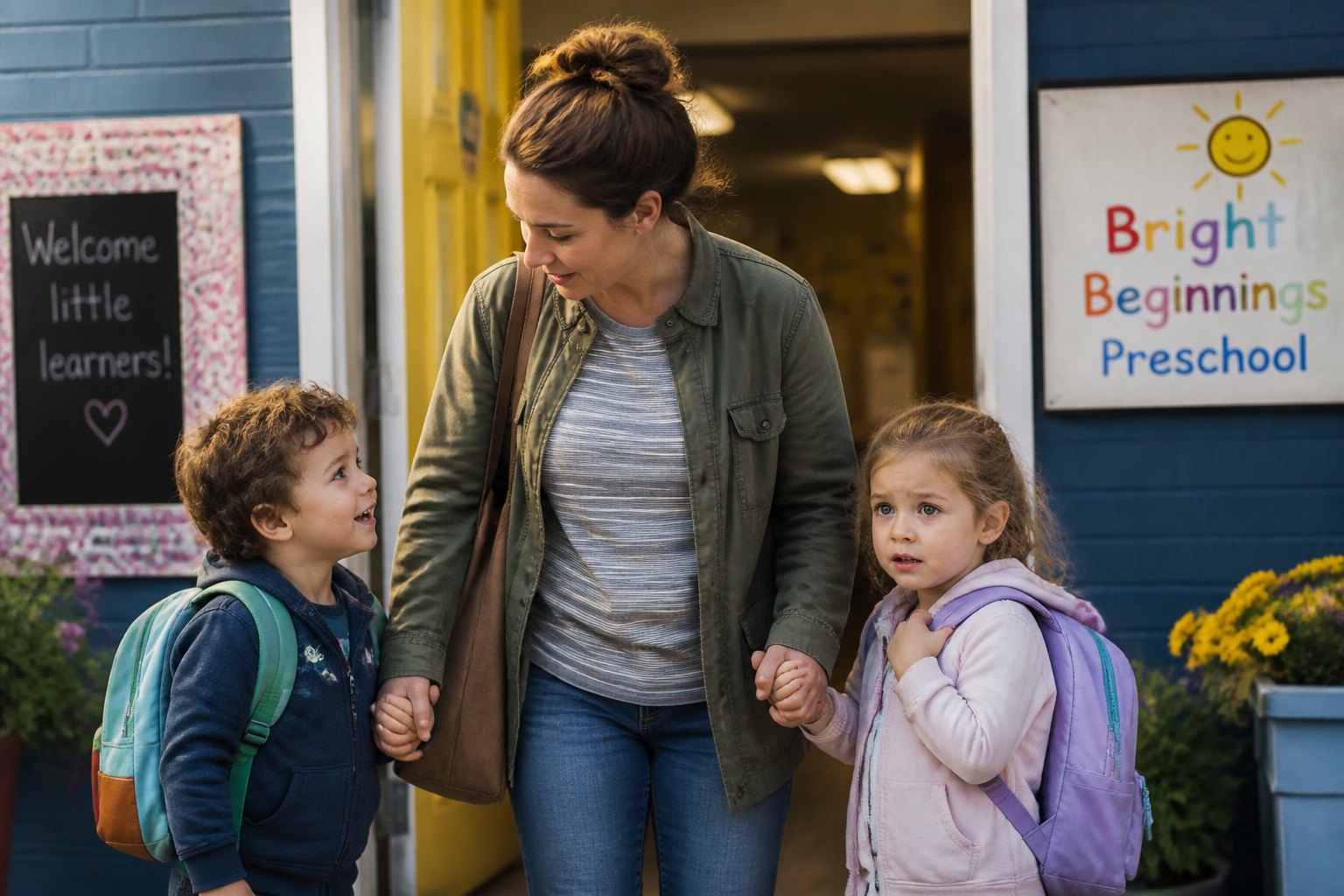
There we were at 7:42 AM, standing in the preschool parking lot with two crying four-year-olds, one inside-out superhero costume, and a lunch box that somehow already had mysterious sticky fingerprints on it. Emma was clinging to my leg like a koala while Max had gone full starfish on the asphalt, declaring he was “never going to school EVER.” Welcome to the reality of twins starting school – where everything takes twice as long and your carefully planned morning falls apart before you’ve had your second cup of coffee.
The truth about twins starting school is that it’s less about cute first-day photos and more about tactical survival. You’re not just managing one child’s emotions, anxieties, and forgotten water bottles – you’re orchestrating a small military operation with twice the moving parts and double the potential for chaos.
The Twin School Readiness Reality Check
Here’s what we wish someone had told us: your twins will not be ready at the same rate. Emma walked into that classroom like she owned the place, while Max spent the first week hiding behind the art easel. This isn’t a reflection of your parenting – it’s just twin life in action.
Most parents focus on academic readiness, but with twins starting school, emotional and social readiness becomes even more complex. Are they ready to be individuals? Can they handle being in different classrooms if needed? These questions matter more than whether they can write their names perfectly.
The 2026 early childhood development guidelines emphasize individualized learning approaches, which actually works in favor of twins who develop at different paces. But it also means you need to advocate for each child’s specific needs rather than treating them as a unit.
Morning Routine Engineering (Because “Getting Ready” is Now a Military Operation)
| Time Block | Single Child Household | Twin Household Reality | Survival Strategy |
|---|---|---|---|
| Wake-up to dressed | 15-20 minutes | 35-45 minutes | Lay out clothes night before, dress one while other brushes teeth |
| Breakfast | 10-15 minutes | 25-30 minutes | Pre-portion everything, serve identical meals to avoid arguments |
| Shoes, backpacks, car | 5-10 minutes | 15-20 minutes | Velcro shoes only, pack bags after dinner previous night |
| Total Time Needed | 30-45 minutes | 75-95 minutes | Start 90 minutes before departure |
The Emotional Logistics No One Warns You About
When one twin loves school and the other doesn’t, you become a daily negotiator. Max would watch Emma skip happily to her classroom while he’d start the tears before we even pulled into the parking lot. The guilt is real, and the emotional juggling act is exhausting.
We learned that acknowledging their different feelings instead of trying to make them feel the same way was key. “Emma, you’re excited! Max, you’re nervous, and that’s okay too.” Simple validation, but it worked better than any pep talk.
The Drop-off Dance
Here’s the brutal truth: your drop-off will take longer than everyone else’s. You’re managing two sets of emotions, two backpacks, and potentially two different classrooms. Other parents will zip in and out while you’re still negotiating with one kid about why we can’t bring the stuffed elephant to show-and-tell when it’s not show-and-tell day.
Managing the Teacher Relationships (Times Two)
Having twins starting school means you’re potentially dealing with two teachers, two classroom cultures, and two different sets of expectations. We made the mistake of assuming both teachers would communicate with each other about our kids. They don’t. You become the information hub.
Create a simple shared document or use a family organization app to track which kid has what homework, permission slips, or upcoming events. Trust us on this – your brain cannot hold all this information, despite what you think in those optimistic morning moments.
The Social Dynamics Minefield
Will they make friends independently? Will they want to play together at recess? What happens when one gets invited to a birthday party and the other doesn’t? These questions kept us up at night those first few weeks.
The reality is messier than the parenting books suggest. Some days Emma would come home talking about her new friend Sarah while Max felt left out. Other days they’d team up at recess and ignore other kids entirely. Both scenarios are normal, but both require different parenting responses.
We found that encouraging individual friendships while not forcing separation was the sweet spot. Let them navigate their social world while staying available for guidance.
Twin Tactics: Pro-Level Shortcuts
– The Buddy System Backup: Arrange pickup/dropoff trades with another twin family. When one of your kids has a meltdown, you have built-in backup who actually understands the chaos.
– Color-Coded Everything: Assign each twin a color for all school items. No more arguments over whose water bottle is whose, and teachers can easily identify belongings.
– The Decoy Snack: Pack an extra identical snack in your car. When one twin inevitably forgets their snack or decides they hate what you packed, you’re prepared without favoritism drama.
– Staggered Bedtime by 15 Minutes: Put the more anxious twin to bed slightly earlier for one-on-one reassurance time. The calm twin gets solo parent time too, and everyone feels heard.
– Emergency Contact Strategy: Make sure the school has different emergency contacts for each twin if possible. If there’s a simultaneous crisis, you need backup who can handle twin logistics.
When Things Don’t Go According to Plan
Three weeks into school, Max started having daily meltdowns while Emma thrived. The comparison was unavoidable and heartbreaking. We questioned everything – was he not ready? Were we pushing too hard? Should we pull him out?
Here’s what we learned: twin timelines are individual timelines. Just because they were born together doesn’t mean they’ll adapt to new situations at the same pace. Max needed extra transition time, more morning snuggles, and a gradual increase in school days. Emma needed independence and new challenges.
The school was incredibly supportive once we communicated what we were seeing at home. Don’t suffer in silence – teachers deal with this more often than you think, especially with multiples.
The Unexpected Wins
About six weeks in, something magical happened. Both kids started talking about school friends, showing us art projects, and racing to their classrooms. The morning chaos didn’t disappear, but it became manageable chaos.
Watching them develop their own identities in separate environments was amazing. Emma discovered she loved dramatic play while Max gravitated toward building blocks. At home, they’d share these new interests with each other, creating a beautiful blend of individual growth and twin connection.
The twins starting school experience taught us that our job isn’t to make their experiences identical – it’s to support them as individuals who happen to be twins.
The Parent-to-Parent Sanity Saver
Pack a “survival kit” in your car: extra underwear, wet wipes, granola bars, and a change of clothes for both kids. The day you need it, you’ll thank yourself for thinking ahead. Also throw in a coffee gift card for yourself – you’ve earned it.
Cheers, Mark & Jen