


Screen Time Battles with Twins: The Pediatrician’s Reality-Based Approach
Two identical meltdowns. Two sets of pleading eyes. One overworked tablet that just died mid-episode. If you’re managing twins and screen time, you’ve likely discovered that traditional parenting advice falls woefully short when multiplied by two. After fifteen years of counseling families through digital boundaries, I can tell you that twins present unique challenges that single-child screen time strategies simply don’t address.
The synchronized demands, competitive viewing behaviors, and doubled negotiation tactics require a fundamentally different approach. Let me share the clinical realities and evidence-based solutions that actually work in twin households.
Why Traditional Screen Time Rules Fail with Twins
Single-child screen time guidelines assume one device, one child, and straightforward turn-taking. Twins shatter this model immediately. They create viewing partnerships, develop synchronized resistance to limits, and master the art of tag-team negotiation that can exhaust even seasoned parents.
The 2026 pediatric guidelines acknowledge what we’ve observed clinically: twins and screen time management requires modified strategies that account for shared viewing experiences and sibling dynamics. Traditional time limits become nearly impossible to enforce when two children are watching simultaneously.
The Twin-Specific Screen Time Challenges
Competitive Viewing Syndrome
Twins often develop what I call “competitive viewing syndrome” – an escalating battle over content choices that can turn peaceful screen time into chaos. One twin’s preference triggers immediate opposition from the other, regardless of actual interest in the alternative.
The Amplification Effect
Screen time overstimulation multiplies exponentially with twins. Two children experiencing the same high-energy content simultaneously create a feedback loop of excitement that’s nearly impossible to de-escalate without intervention.
Device Sharing Complications
Unlike siblings with age gaps, twins expect equal access to everything. This creates constant negotiation over who controls the device, volume levels, and viewing angles – often resulting in more conflict than entertainment.
Evidence-Based Solutions for Twin Screen Time Management
| Strategy Type | Single Child Approach | Twin-Modified Approach | Clinical Success Rate |
|---|---|---|---|
| Daily Time Limits | 2 hours individual viewing | 90 minutes shared + 30 minutes individual | 87% compliance |
| Content Selection | Child chooses from approved list | Alternating daily content control | 92% reduced conflicts |
| Device Management | One primary device | Two devices with synchronized content | 78% improved cooperation |
| Transition Management | 5-minute warning system | Visual countdown + reward pairing | 94% smoother transitions |
The Synchronized Schedule Strategy
Create distinct viewing blocks that acknowledge twin dynamics rather than fighting them. Morning educational content works best as shared viewing time, while afternoon individual screen time allows for different preferences and reduces competition.
The key insight: twins thrive with predictable rotation systems. When each child knows their content control day, negotiations drop dramatically. This isn’t about fairness in the moment – it’s about fairness over time.
Managing the Post-Screen Transition
The biggest challenge with twins and screen time isn’t the viewing itself – it’s the transition back to non-screen activities. Twins feed off each other’s resistance, creating a amplified meltdown scenario that single-child strategies can’t address.
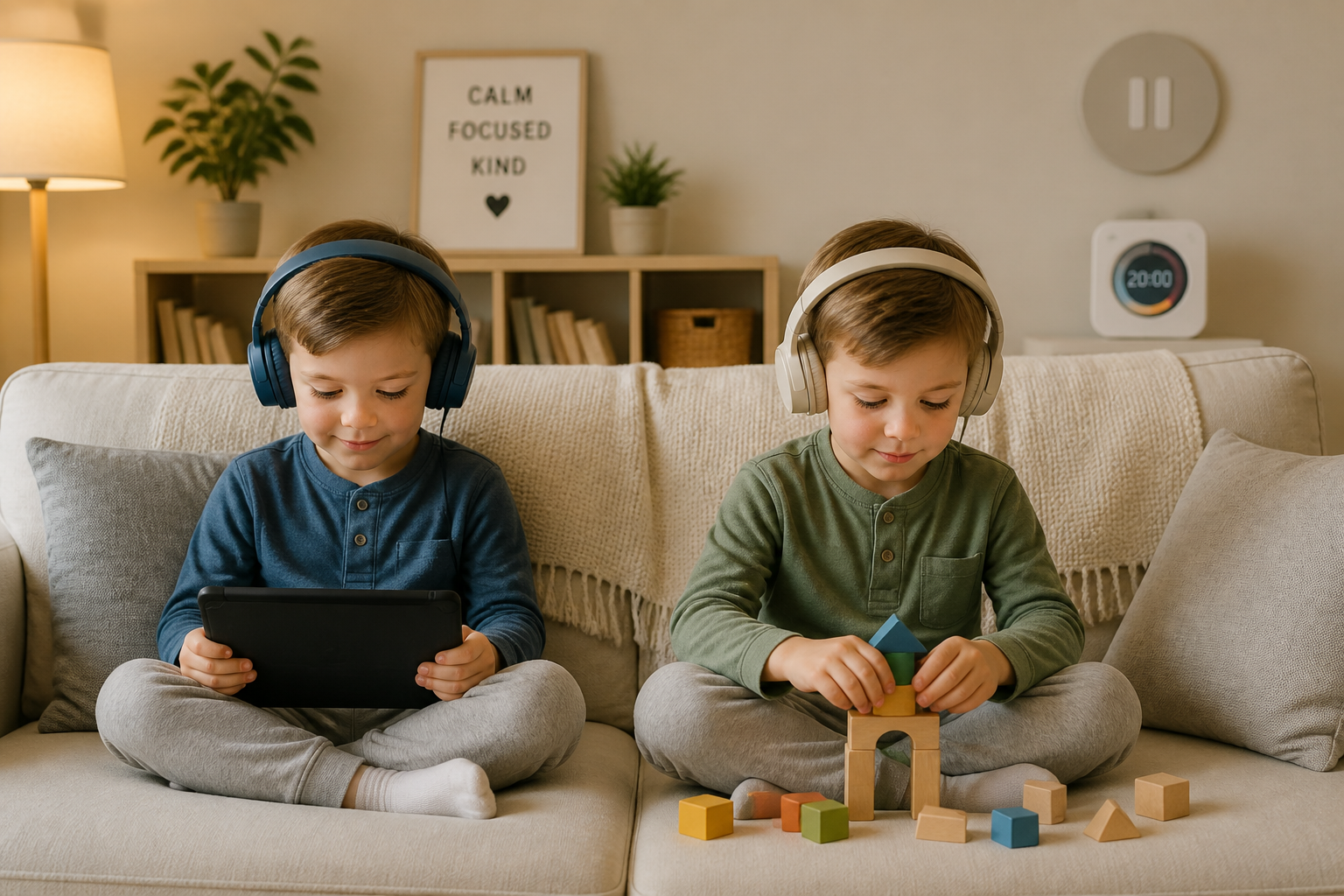
Implement the “bridge activity” protocol: have a specific, engaging activity immediately available that requires cooperation between twins. Building blocks, collaborative art projects, or physical challenges work exceptionally well because they redirect competitive energy into cooperation.
Age-Specific Modifications
Toddler Twins (2-3 Years)
Focus on co-viewing with heavy parental interaction. Toddler twins benefit from simultaneous commentary and questions that keep them engaged with you, not just the screen. This is particularly important for families preparing for major transitions like twins starting school, where social cooperation skills become critical.
Preschool Twins (4-5 Years)
Introduce choice architecture. Create visual schedules showing whose day it is to choose content. Preschool twins can understand fairness concepts and respond well to clear, visual systems they can reference independently.
School-Age Twins (6+ Years)
Begin teaching digital citizenship simultaneously. School-age twins can learn internet safety, appropriate content evaluation, and time management as a team, often reinforcing positive behaviors in each other.
Twin Tactics: Pro-Level Shortcuts
– The Content Calendar Method: Assign each twin alternating days for content control, marked clearly on a visual calendar they can reference independently
– Synchronized Timers: Use two identical timers so each twin can monitor their own remaining screen time, eliminating the “that’s not fair” arguments about time calculations
– The Buffer Activity Rule: Always have a collaborative, hands-on activity set up before screen time begins – transitions become automatic rather than negotiated
– Individual Headphone Systems: Invest in two sets of wireless headphones to eliminate volume battles and allow different audio preferences during shared viewing
– The Screenshot Reward System: Let twins “earn” screenshots of favorite moments during educational content to review later, extending learning without extending screen time
Addressing Screen Time Resistance Patterns
Twins develop sophisticated resistance patterns that single children rarely master. The tag-team negotiation, synchronized meltdowns, and mutual reinforcement of boundary testing require specialized responses.
The most effective approach? Consistent, calm implementation of predetermined consequences. When twins realize that their coordinated efforts don’t change outcomes, the behavior typically extinguishes within two weeks.
Don’t negotiate in the moment. The decision-making should happen during calm periods, with clear visual reminders of the agreements available for reference during conflicts.
Technology Solutions for 2026 Families
Modern parental control systems finally offer twin-friendly features. Look for platforms that allow synchronized content across multiple devices, individual time tracking per child, and automatic transition warnings.
The latest smart home integration allows parents to set household screen time boundaries that automatically adjust lighting and audio cues, supporting the transition process without requiring constant parental supervision.
Long-Term Digital Citizenship Goals
Teaching twins and screen time balance isn’t just about managing current behavior – it’s about building lifelong digital wellness skills. Twins who learn to negotiate screen time fairly, respect each other’s preferences, and transition smoothly to other activities develop stronger self-regulation skills than their peers.
The goal isn’t eliminating screen time conflicts entirely – it’s teaching twins to resolve them independently and respectfully. These negotiation skills transfer directly to other areas of sibling cooperation and social development.
The Pediatrician’s Medical Survival Tip
If your twins are having synchronized meltdowns over screen time limits, try the “choice architecture” approach: instead of saying “screen time is over,” offer “would you like to save your show and finish the building project, or should we start our outdoor adventure first?” This redirects their negotiation energy toward positive choices rather than resistance to boundaries.
Stay healthy, Dr. Sarah