

Why Do Some Twin Babies Wear Helmet Therapy? Understanding Plagiocephaly in Multiples
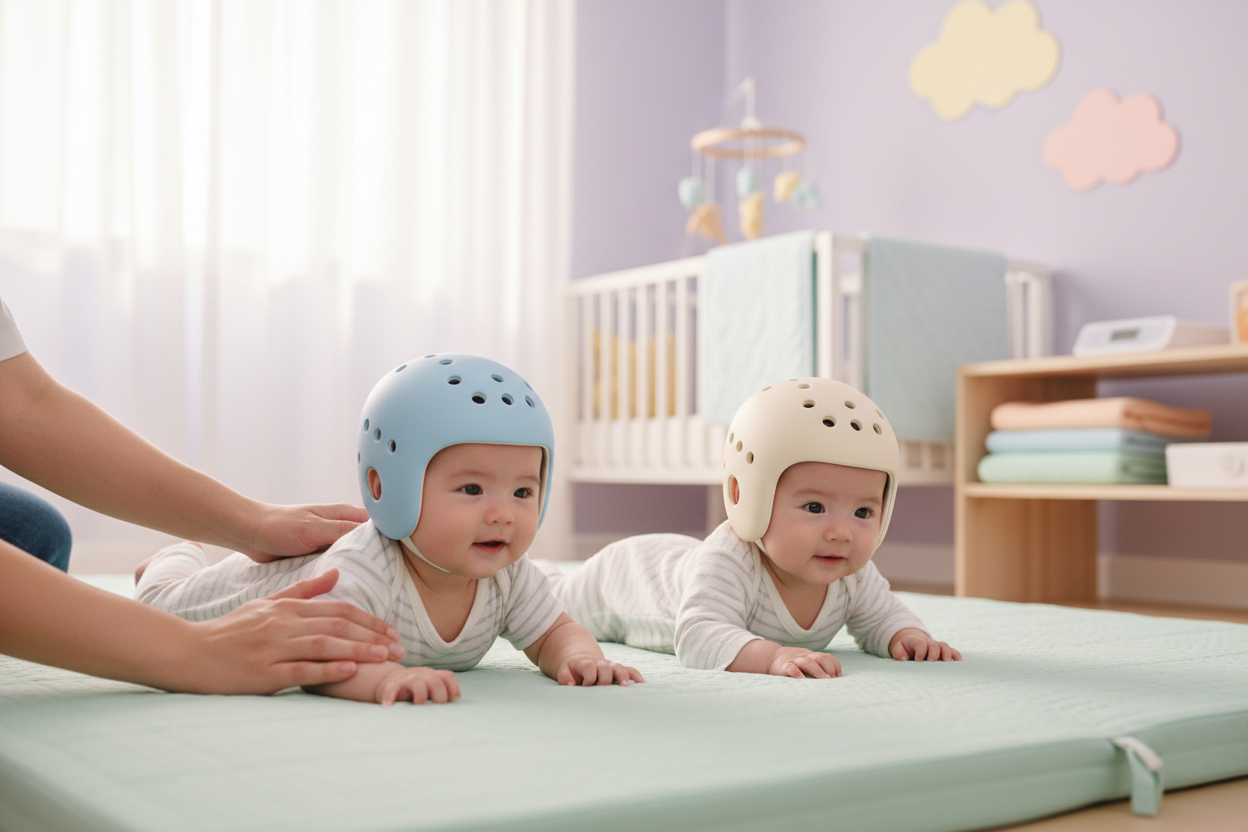
I recently examined twin boys who returned for their 6-month checkup wearing matching blue helmets. Their mother explained how tummy time had been particularly challenging with two babies to manage. These custom-molded helmets weren’t fashion statements—they were medical devices treating positional plagiocephaly, a condition particularly common in twins. With the 2026 updated safety protocols now recommending more supervised tummy time for multiples, understanding when and why twin babies might need helmet therapy has become essential knowledge for parents of multiples.
When caring for twins, sleep positioning becomes especially crucial. Parents often struggle with newborn twins bassinet sharing, which can inadvertently contribute to positioning issues that may later require intervention.
What Is Plagiocephaly and Why Are Twins More Susceptible?
Plagiocephaly (often called “flat head syndrome”) is a condition where a baby develops a flat spot on one side or the back of the head. This flattening occurs because a baby’s skull remains soft and malleable during the first year of life.
Twins face several unique risk factors that make them particularly susceptible to developing plagiocephaly:
– Intrauterine constraint: Limited space in the womb often forces twins into fixed positions
– Prematurity: Twins are more likely to be born early when skulls are especially soft
– NICU stays: Extended hospital care often means more time on their backs
– Feeding challenges: Parents of twins may have less opportunity for position changes during feeding sessions
– Reduced tummy time: Managing two babies often results in less supervised prone positioning
Studies show that twins have approximately 1.7 times higher risk of developing plagiocephaly than singleton infants, with even higher rates in identical twins who shared the same amniotic sac.
How to Identify When Twin Baby Helmets Might Be Needed
Early identification is crucial. Here are the key signs that might indicate the need for helmet therapy:
Visual Assessment Indicators
– Flattening on one side or back of the head
– Asymmetrical ear positioning
– Facial asymmetry
– Uneven cheekbones or jaw alignment
– One eye appearing larger than the other
– A pronounced bald spot on one area of the head
Pediatricians typically use caliper measurements and sometimes 3D imaging to determine the severity. The cranial vault asymmetry index (CVAI) has become the standard measurement tool in 2026, with values above 8.5% typically warranting further intervention.
Prevention vs. Treatment: What Twin Parents Need to Know
| Intervention | Timing | Effectiveness | Twin-Specific Considerations |
|---|---|---|---|
| Repositioning Therapy | 0-4 months | High (80-90% resolution) | Requires consistent position changes for both babies |
| Helmet Therapy | 4-8 months optimal | High (95% resolution) | Double equipment cost; coordination of appointments |
| Combined Approach | 4-12 months | Highest (98% resolution) | Most demanding on parental resources but most effective |
Prevention always remains preferable to treatment. The American Academy of Pediatric Neurosurgery’s 2026 guidelines emphasize the importance of tummy time for twins, recommending at least 40-60 minutes of supervised prone positioning daily, distributed throughout waking hours.
The Twin Baby Helmet Process: What to Expect
If helmet therapy is recommended for one or both of your twins, here’s what the process typically involves:
1. Evaluation: Specialized assessment by a craniofacial specialist or neurosurgeon
2. Custom fitting: Each twin baby helmet is individually molded using 3D scanning technology
3. Wear protocol: Typically 23 hours per day for 2-6 months
4. Regular adjustments: Bi-weekly appointments to adjust the helmet as the head grows
5. Progress monitoring: Regular 3D scans to document improvement
The newest generation of helmets in 2026 includes integrated growth sensors that can transmit data directly to providers, reducing the frequency of in-person visits—a welcome advancement for parents managing twins.
Twin Tactics: Pro-Level Shortcuts
- Synchronized tummy time: Place twins facing each other during tummy time to increase engagement and tolerance
- Double nursing pillow method: Use twin-specific nursing pillows for bottle feeding to maintain optimal head positioning while feeding both babies
- Alternating crib orientation: Change the orientation of each twin in their crib weekly to prevent consistent pressure on the same spot
- Tag-team repositioning: Set synchronized alarms for overnight position checks, with each parent taking alternate shifts
- Helmet decoration strategy: If helmets are needed, designate “decoration days” when siblings and family can personalize the helmets, making them a source of pride rather than medical devices
Insurance Coverage and Financial Considerations for Twin Helmet Therapy
The financial aspect of twin baby helmets requires special consideration. With each custom helmet costing between $1,500-3,000, parents of twins face potential expenses of $3,000-6,000.
Insurance coverage varies widely. The 2026 Pediatric Medical Device Access Act has improved coverage for cranial orthotic devices, but many policies still classify them as “cosmetic.” Documentation of medical necessity from multiple specialists often improves coverage chances.
For twins specifically, some manufacturers now offer “twin discounts” of 15-25% on the second helmet, which can provide meaningful savings.
When Is the Right Time to Start and Stop Helmet Therapy?
Timing is crucial for successful treatment. The optimal window for beginning helmet therapy is between 4-6 months of age when:
1. Repositioning therapy has proven insufficient
2. The baby has good neck control
3. The skull is still growing rapidly
4. The CVAI exceeds the threshold for intervention
Treatment typically continues until the baby reaches 12-14 months or until measurements normalize. For twins born prematurely, adjusted age is used to determine appropriate timing.
Common Questions About Twin Baby Helmets
Do both twins always need helmets?
Not necessarily. While genetic factors may predispose twins to similar head shapes, environmental factors like sleeping position may affect each child differently. It’s common for one twin to require a helmet while the other does not.
How do helmets affect twin bonding?
Helmets don’t interfere with physical closeness or bonding. In fact, many parents report that the helmets sometimes facilitate certain types of twin interactions, like the gentle “bonk” of helmets touching becoming a game between twins.
Will helmets delay developmental milestones?
The lightweight design of modern helmets doesn’t impede physical development. The 2026 models weigh under 6 ounces and are specifically designed to accommodate gross motor development.
The Pediatrician’s Medical Survival Tip
When managing twins with helmets, create a dedicated “helmet-free hour” each day (during their allowed hour off) where you focus intensely on quality tummy time. This concentrated effort helps strengthen neck muscles and provides crucial relief for both babies and parents while still supporting proper head development.
Stay healthy,
Dr. Sarah