


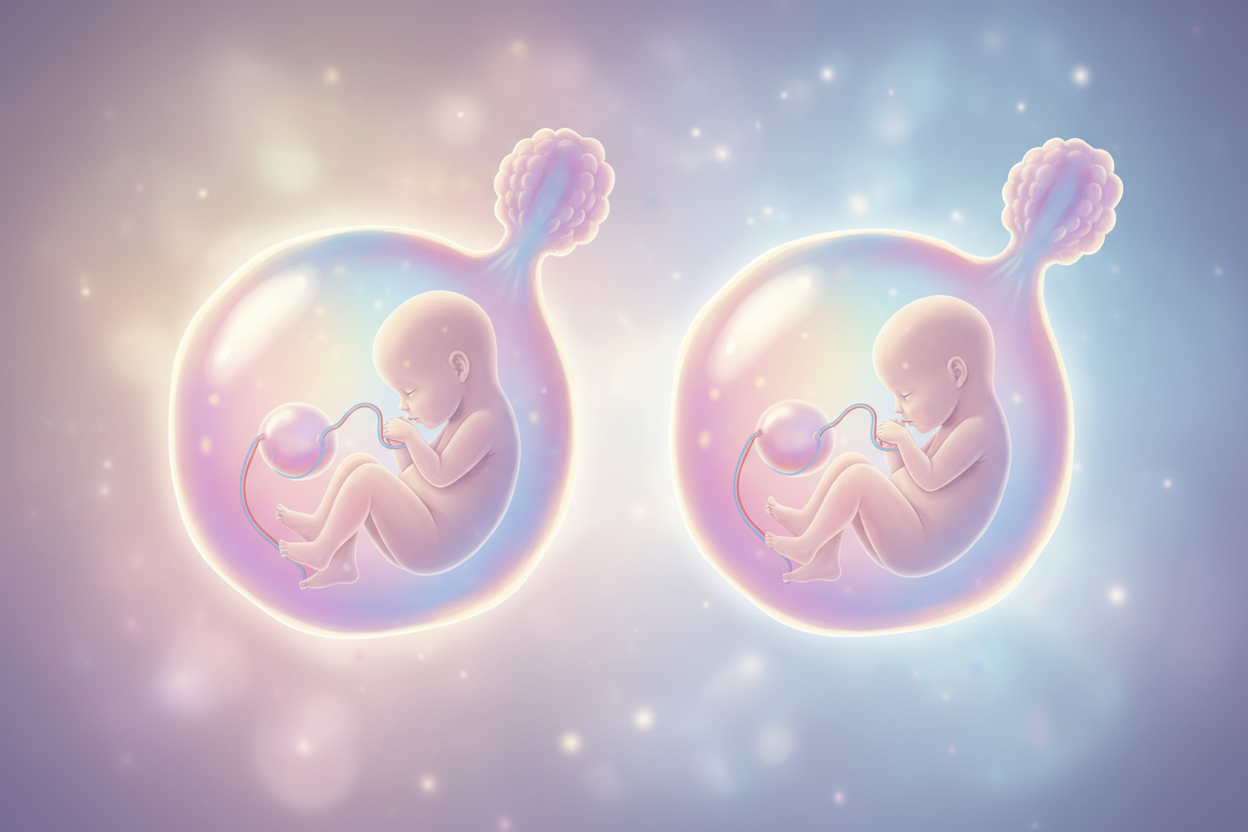
Di-Di Twins Meaning: The Complete Guide to Dichorionic-Diamniotic Twins
The ultrasound technician moves the wand across your abdomen and suddenly announces, “I see two sacs with two placentas—these are di-di twins.” The revelation stops time for most expectant parents, but understanding di-di twins meaning is crucial for navigating your twin pregnancy journey. As a fetal medicine specialist, I’ve guided thousands of parents through this exact moment of discovery and the subsequent months of specialized care these pregnancies require.
Di-di twins, short for dichorionic-diamniotic twins, represent the most common type of twin pregnancy, accounting for approximately 70% of all twin pregnancies. Each baby develops within its own amniotic sac with its own placenta, creating important clinical implications for monitoring and delivery planning. Higher hCG levels for twins are often the first indicator that leads to the ultrasound where chorionicity is determined.
What Does Di-Di Twins Mean Medically?
Dichorionic-diamniotic is the technical term describing the membrane and placental arrangement in twin pregnancies. Let’s break down exactly what this means:
– Dichorionic: “Di” means two, and “chorionic” refers to the chorion—the outer membrane that develops into the placenta. Di-di twins have two separate chorions, meaning two placentas.
– Diamniotic: Again, “di” means two, and “amniotic” refers to the amniotic sac. Each baby has its own amniotic sac filled with protective fluid.
This configuration creates the safest environment for twin development because each twin has their own life support system. According to the 2026 clinical guidelines from the American College of Obstetricians and Gynecologists, di-di twins have the lowest complication rates among all twin types.
How Di-Di Twins Form: The Biology
Di-di twins form in one of two ways:
Fraternal Twins (Dizygotic)
Most di-di twins are fraternal, occurring when two separate eggs are fertilized by two separate sperm. These twins:
– Share approximately 50% of their DNA (like regular siblings)
– Can be different sexes
– May look similar but not identical
– Always have separate placentas and amniotic sacs
Identical Twins (Monozygotic)
Some di-di twins can actually be identical, though this is less common. This happens when:
– A single fertilized egg splits very early (within the first 3 days after fertilization)
– Despite sharing 100% of their DNA, these twins develop separate placentas and amniotic sacs
– They will be the same sex
– Recent 2026 research indicates this occurs in approximately 8-10% of identical twins
Comparing Types of Twin Pregnancies
| Twin Type | Placenta Arrangement | Amniotic Sac Arrangement | Twin Type | Complication Risk |
|---|---|---|---|---|
| Di-Di Twins | Two separate placentas | Two separate amniotic sacs | Usually fraternal (90%) Sometimes identical (10%) |
Lowest risk |
| Mo-Di Twins | One shared placenta | Two separate amniotic sacs | Always identical | Moderate risk (Twin-to-Twin Transfusion risk) |
| Mo-Mo Twins | One shared placenta | One shared amniotic sac | Always identical | Highest risk (Cord entanglement) |
How Di-Di Twins Are Diagnosed
Determining chorionicity (the placental arrangement) is critical and should be established early in pregnancy. The most accurate time for diagnosis is between weeks 10-14 of pregnancy.
First Trimester Ultrasound
During early ultrasound, technicians look for:
– The “lambda” or “twin peak” sign: a triangular projection of placental tissue between the membrane layers
– Clear visualization of separate placentas
– Thick membrane between twins (>2mm)
New 2026 high-resolution 4D ultrasound technology has increased accuracy of chorionicity determination to over 98% when performed before 14 weeks.
Later Pregnancy
If chorionicity wasn’t determined early, it becomes progressively more difficult as pregnancy advances. After 20 weeks, determination relies on:
– Different fetal sexes (confirming di-di)
– Separate placentas visible
– Membrane thickness measurements
Many parents first learn they’re having twins when their maternal fetal medicine twins specialist conducts a detailed anatomical scan, which often includes determining chorionicity.
Medical Management of Di-Di Twin Pregnancies
While di-di twins have the lowest complication rate among twin types, they still require specialized care:
Monitoring Schedule
– Routine ultrasounds every 4 weeks after 20 weeks
– Growth scans to monitor for discordant growth (>20% size difference)
– Increased frequency of prenatal visits
– Non-stress tests starting at 32-34 weeks
Common Complications
Despite being lower risk, di-di twins still face higher complication rates than singleton pregnancies:
– Preterm birth (50% deliver before 37 weeks)
– Gestational diabetes (1.5-2x higher risk)
– Preeclampsia (2-3x higher risk)
– Placenta previa
– Postpartum hemorrhage
Twin Tactics: Pro-Level Shortcuts
- Request early chorionicity determination: Ask specifically for chorionicity determination at your first ultrasound, as it shapes your entire prenatal care plan.
- Create a twin-specific birth plan: Di-di twins may allow for vaginal delivery if Twin A is head-down; discuss this possibility early.
- Monitor for preeclampsia at home: Acquire a blood pressure cuff and check weekly, recording readings to share with your doctor.
- Prepare for potential NICU time: Even di-di twins often arrive 2-3 weeks early; tour the NICU facilities in advance.
- Get proper twin growth assessment: Insist on twin-specific growth charts, not singleton growth standards, for accurate monitoring.
Long-Term Outcomes and Expectations
One of the most frequent questions I get from expectant parents is about the long-term outlook for di-di twins. Here’s what the data tells us:
– Di-di twins typically develop normally, with developmental milestones slightly delayed (1-2 months) in the first two years before equalizing
– Prematurity remains the biggest risk factor for developmental concerns
– With current medical advances, over 95% of di-di twins born after 32 weeks have identical outcomes to singletons by school age
– Twin-specific early intervention programs show excellent results when needed
Birth and Delivery Considerations
For di-di twin pregnancies:
– Optimal delivery timing is between 37-38 weeks
– Vaginal delivery is possible if Twin A is vertex (head-down)
– C-section rates are approximately 60-70%, higher than singleton pregnancies
– Delivery should occur in a facility with Level III NICU capabilities
The Pediatrician’s Medical Survival Tip
When preparing for di-di twins, establish a relationship with a high-risk OB and pediatrician by 20 weeks. Create a concrete plan for who will care for any older children when you go into labor, as twin deliveries often happen unexpectedly and may require longer hospital stays. Have this plan ready by 30 weeks with primary and backup options clearly established.
Stay healthy,
Dr. Sarah