

Do Twins Skip a Generation? Debunking The Family Myth That Won’t Die
“So, which side of the family do the twins come from?” asked our neighbor as we struggled to fit our double stroller through the doorway of our local coffee shop. Before we could answer, she added, “They must have skipped a generation, right? That’s how it works!”
If we had a dollar for every time we heard the “twins skip a generation” theory, we could have funded our twins’ college educations by now. As parents of fraternal twins, we’ve become unwitting experts on twin genetics – mostly by necessity and countless late-night Google searches during those endless feeding sessions.
Let’s separate twin fact from family fiction and explore whether there’s any truth to this persistent belief that twins “skip” generations.
The Science Behind Twin Genetics: No Skipping Allowed
Here’s the scientific reality: twins don’t actually “skip” generations in any biological sense. That’s not how genetics works. What people are observing is a pattern that seems like skipping, but the underlying mechanisms are much more complex.
Types of Twins and Their Genetic Patterns
First, let’s distinguish between the two main types of twins:
Identical (Monozygotic) Twins:
– Result from one fertilized egg splitting into two embryos
– Share 100% of their DNA
– Are not hereditary in the traditional sense
– Occur randomly at a fairly consistent rate globally (about 3-4 per 1,000 births)
Fraternal (Dizygotic) Twins:
– Result from two separate eggs being fertilized by two separate sperm
– Share about 50% of their DNA (like regular siblings)
– Can run in families
– Frequency varies by population and family history
The “skipping generations” myth primarily applies to fraternal twins, which brings us to the real genetic mechanism at play.
The Female Factor: Where The “Skipping” Myth Comes From
The tendency to have fraternal twins can be inherited, but only through the maternal line. Women who inherit a gene for hyperovulation (releasing multiple eggs during ovulation) are more likely to conceive fraternal twins naturally.
| Family Member | Has “Twin Gene” | Can Pass It On | Increased Chance of Having Twins |
|---|---|---|---|
| Mother | Yes | Yes (to daughters) | Yes (1.5-2x higher) |
| Father | Yes | Yes (to daughters) | No (can’t ovulate) |
| Daughter | Maybe | Yes (if inherited) | Yes (if inherited) |
| Son | Maybe | Yes (to daughters only) | No (can’t ovulate) |
Here’s where the “skipping” appearance comes in:
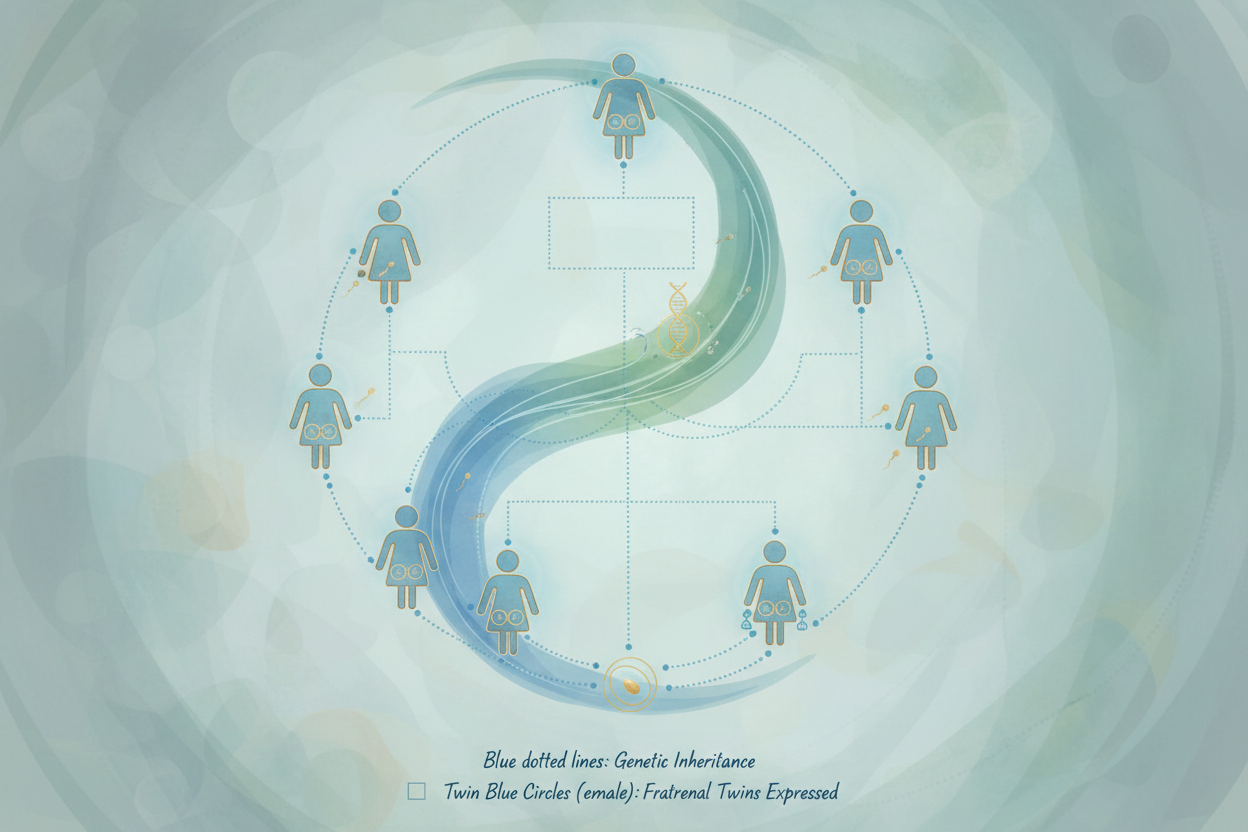
1. A woman with the hyperovulation gene has fraternal twins
2. She passes this gene to her son
3. The son cannot have twins himself (men don’t ovulate!)
4. The son passes the gene to his daughter
5. The daughter has fraternal twins
To the casual observer, it looks like twins “skipped” the son’s generation – but the gene didn’t skip anything. It was there all along, just unable to express itself in a male.
What About Identical Twins?
The most up-to-date research from 2026 suggests that while identical twinning has long been considered completely random, there may actually be some genetic components involved. Recent studies have identified several genetic markers that slightly increase the chance of a fertilized egg splitting. However, these genetic factors play a much smaller role than with fraternal twins.
Modern Factors Affecting Twin Rates
While we’re managing twin toddlers in 2026, we’re seeing twin rates quite different from previous generations. Several modern factors influence twin pregnancies:
– Advanced maternal age: Women over 35 naturally release multiple eggs more frequently
– Reproductive technologies: Even with single-embryo transfer being standard now, IVF still results in more twin pregnancies
– Global mobility: Population mixing has changed the genetic landscape
– Health factors: Body mass index, height, diet, and even environmental factors affect twinning rates
Twin Tactics: Pro-Level Shortcuts
- Family Tree Investigation: Map out the maternal line specifically looking for fraternal twins – that’s your genetic link.
- Genetic Testing: The 2026 OvaChip test can identify if you carry hyperovulation genes with 92% accuracy.
- Statistical Reality Check: Even with a family history, your chances of fraternal twins naturally is only about 1 in 60 births (without fertility assistance).
- Conversation Ender: When someone mentions the “skipping generations” myth, simply reply, “Actually, the gene is just hiding in the men who can’t use it!”
- Preparation Wisdom: If fraternal twins run in your maternal line, consider twin-preparation even if your doctor hasn’t identified twins yet.
When Twin History Matters Medically
If you’re trying to conceive or are already pregnant, a family history of twins is worth mentioning to your healthcare provider. With the new 2026 prenatal guidelines, this information might:
– Prompt earlier ultrasounds
– Change monitoring frequency
– Inform nutritional recommendations
– Prepare you for the possibility of a 20-week twin pregnancy milestone that looks very different from singleton pregnancies
Other Twin Myths We Need To Bust
While we’re debunking myths, let’s tackle a few other persistent twin fallacies:
1. “Twins feel each other’s pain” – While there’s often a strong bond, there’s no scientific evidence for psychic connections.
2. “Twins have identical fingerprints” – Even identical twins have unique fingerprints formed by random factors in the womb.
3. “Eating yams increases your chances of twins” – This myth stems from observations in certain African populations, but the correlation hasn’t been proven causative.
4. “Twins always skip a generation” – As we’ve established, this isn’t how genetics works!
The Modern Twin Genetics Reality
The “twins skip a generation” saying oversimplifies complex genetic realities. With fraternal twins, the predisposition doesn’t skip generations – it just might not be expressed when the gene carrier is male.
With identical twins, the genetics are only beginning to be understood, but the notion of “skipping” doesn’t apply in any meaningful way.
Next time a well-meaning relative mentions twins skipping generations at your family reunion, you’ll be armed with the genetic facts to gently correct them. Or, if you’re exhausted like most twin parents, just smile and nod while silently rolling your eyes.
The Parent-to-Parent Sanity Saver.
Keep a pre-written note in your phone explaining twin genetics to share with curious strangers. It saves you from explaining the same concepts repeatedly while sleep-deprived, and lets you add humor and personality when you’re not exhausted from reciting Twin Biology 101 for the fifth time that day.
Cheers,
Mark & Jen